One does not need to exert much effort to use a pushbutton switch, as they can be activated with the touch of a finger. There is no need to pull, turn, or solve a puzzle, which makes them ideal in industrial applications where they are regularly used for long periods of time.

Below are some factors to consider when selecting your switch.
Duration and Circuit Flow
There are two kinds of durations: momentary and maintained. Momentary pushbuttons are used in processes where the button should be held continuously for operation. Once released, the process will stop until the button is pressed again.
For maintained durations, once the button is pressed, the operation will run consistently until the button is pressed again.
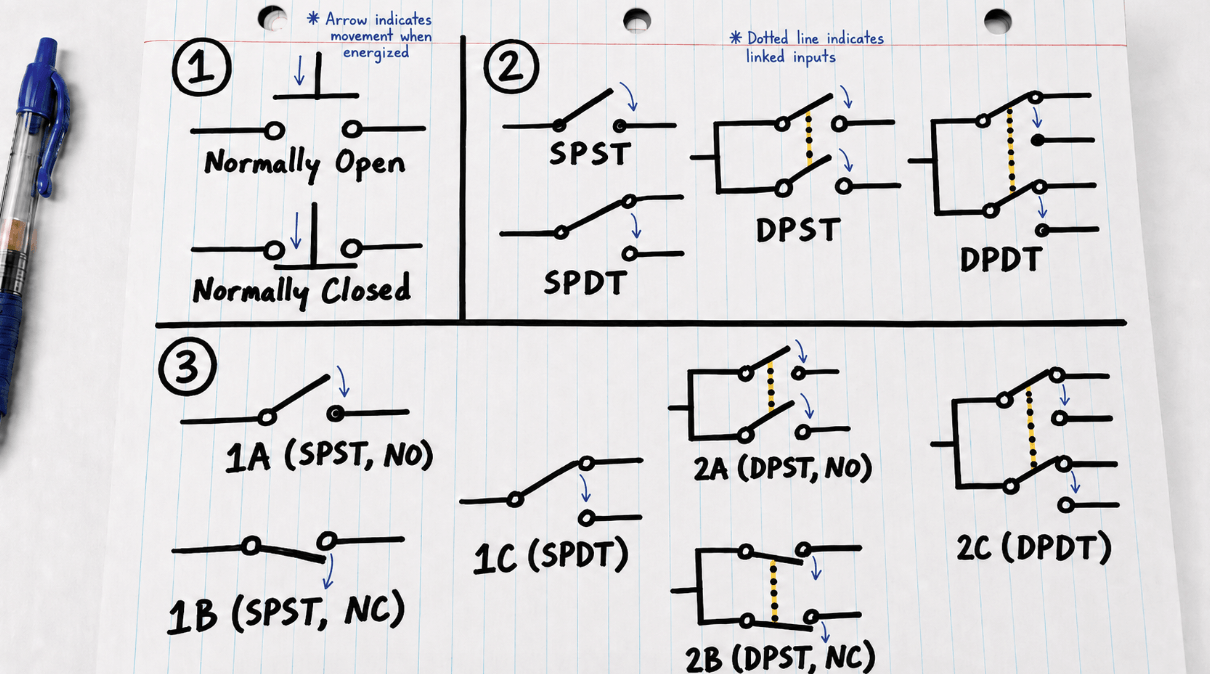
For Pushbutton switches that are labeled as “N/C” (Normally Closed), the circuit is closed and activated until the button is pressed to open it. Conversely, “N/O” (Normally Open) circuits are open until the button is pressed to close the circuit.
Shape
Initially, it may seem like shape would be a cosmetic factor in choosing a pushbutton, but there are also ergonomic reasons for choosing a round head vs a square or rectangular head. Round heads are user-friendly and well-suited for routine operations, such as turning a machine on and off.
Visually, rectangular heads stand out against a panel of round pushbuttons, which can also aid in communicating the purpose of the processes that they control. In operations that are more specialized, such as occasional cleaning and maintenance, one might opt to install pushbuttons that look distinctive.

A yellow pushbutton switch with a round head
Illumination and Color
Some pushbutton switches contain an LED light. When lit, the LED light aids with visibility and communication, indicating that a process is in use. Seeing a bright-colored light can reduce human error, as users are more likely to recognize and understand the status of an operation rather than second-guess. This factor also makes Illuminated push button switches optimal in environments with low visibility, smoke, or harsh weather.
Common colors and their meanings that are used in electronic controls are:
Red: Stop, Off, Error, Emergency Stop, Out of Order
Yellow: Return, Pause, Change in Process, Attention, Caution
Green: On, Ready, Safe Conditions, In Use
Black: Can be an “On/Off” function
Blue/Other: Custom presets specific to the machine or operation, or any functions not already listed above, such as reset and maintenance-related functions.

The AR16 Series feature a wide variety of pushbutton switches in different colors, shapes, and sizes. This pushbutton has a rectangular head with a red LED light.
The ease and method of installation is another factor to consider when selecting pushbutton switches. As these parts get used often, they do require regular replacement. It is recommended that one should keep several copies of one type of model on hand.
Common installation types include:
Solder Terminal: Metal pins or tabs are welded into place with a soldering iron. This connection can handle high currents and voltages. While relatively easy, soldering does take a bit of practice and skill to ensure a quality solder joint.
Screw Terminal: Wires are held in place by screws. This connection can handle high currents and voltages. Caution should be taken to ensure that the screws are properly tightened. If they are set in too tight or too loose, it can affect the quality of the current.
Insertion Terminal (Plug): The unit can easily be installed by pushing it into a socket without using installation tools. However, these may become loose over time and need to be replaced often.
Safety Features
Some pushbutton switches come with a protective cover. This cover not only prevents the switch from wear but can serve as an additional barrier for buttons that control crucial emergency processes so that they are not mistakenly pressed.
MISUMI also carries protective covers that are sold separately as accessories. They can be installed externally over the unit.

Fuji Electric’s AM9D762 is a protective cover with a translucent hinged front that can be lifted to access the button. It can be installed over both round and rectangular heads.
Certifications
Many of the Pushbutton Switches that MISUMI carries are UL-listed and have additional international certifications. MISUMI’s own PB3C series is UL, CE, TUV, CCC, and CSA certified.

Pushbutton switch with round head
MISUMI carries a wide selection of pushbutton switches, from brands such as IDEC and Fuji Electric, as well as our own MISUMI brand. To view our offering of pushbutton switches, click here.