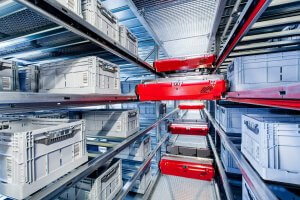
Pick-to-light systems use LED displays and confirm buttons at storage locations to guide operators through paperless order picking, cutting search time and picking errors. As part of our warehouse automation series on the Internet of Things (IoT) era, this guide explains how the technology works and which mechanical components you need to build one.

What Are Pick-to-Light Systems?
Pick-to-light systems are simple but robust order-fulfillment technology designed to streamline picking, improve accuracy, and lower labor costs. They are paperless: alphanumeric displays and buttons are installed at storage locations and guide employees through light-aided manual picking, putting, and sorting of packages or products.
Quick definition: A pick-to-light system lights the exact storage location, shows the quantity to pick, and waits for the operator to press a button to confirm. Nothing is printed, and the operator never has to search for a location.
How Does Pick-to-Light Work?
Here is a step-by-step description of how a typical pick-to-light system operates.
The operator scans the barcode on a temporary or reusable holding container, such as a shipping carton. This links the container to a specific order.
The alphanumeric display, typically LED, lights up to guide the operator to the indicated storage location. The display then shows which item and how many to pick.
The operator picks the items, places them in the holding container, and presses the button to confirm the pick.
The system illuminates each location in turn until every item on the order has been picked and placed in its holding container.
Depending on the system, the LED display can be paired with an acknowledgment button and a digital readout for more detailed instructions and options.

Engineering note: The confirm-button press is the data point that makes the system valuable. Each press records which location was picked, how many units, and when, which is what feeds pick-rate reports and inventory updates when the system is linked to a WMS.
Pick-to-Light vs. Put-to-Light
Put-to-light systems are essentially the opposite of pick-to-light: they reverse the flow. Instead of directing an operator to take items from storage to fill an order, a put-to-light system guides the operator to place incoming goods where they belong, whether that is a retail store order, a customer order, or any other organizational grouping.
- Flow: from storage locations into an order container
- Light shows: where to pick and how many
- Typical goal: fulfill customer orders accurately
- Flow: from incoming goods into order or destination locations
- Light shows: where to put each item and how many
- Typical goal: sort and distribute by order, store, or customer
Benefits of Pick-to-Light Systems
Ease of use
Training operators in traditional picking can take hours or more, depending on warehouse size and complexity. With an efficient pick-to-light system, companies can cut training down to 30-45 minutes.
System integration
A pick-to-light system can be installed standalone or integrated with an existing warehouse management system (WMS), enterprise resource planning (ERP), supply chain management, or other host systems. Advanced systems can produce pick-rate reports, analyze productivity, and allow the size of work zones to vary to match labor to order volume.
Increased efficiency
Systems are usually organized by your existing work zones, which minimizes walking. If an order must pass through multiple zones, the system follows the order and reduces idle time. Some systems mount onto mobile carts or conveyor systems so one operator can fulfill an entire order across many zones.
Paperless operation
Operators save time by eliminating traditional paper-based record keeping.
Improved order accuracy
From a customer-service standpoint, the greatest benefit is fewer picking errors, which improves order-fulfillment performance.
Lower labor costs
Picking is one of the biggest expenses in warehouse operations. Less walking, shorter fulfillment time, and greater accuracy combine to reduce labor cost.
Building a pick-to-light station, cart, or shelving line?
Shop Factory Frames Browse Aluminum ExtrusionPick-to-Light vs. Other Picking Methods
Pick-to-light is one of several ways to direct manual picking. The table below compares the approaches on the factors that most often drive the decision.
| Method | Operator guidance | Hands and eyes | Fixed infrastructure at locations | Best fit |
|---|---|---|---|---|
| Paper pick list | Printed list; operator finds each location | Hands busy with paper | None | Low volume, simple layouts |
| Handheld RF scanner | Screen directs and scan verifies | One hand occupied by scanner | Barcode labels | Large, changing SKU ranges |
| Voice picking | Spoken instructions through a headset | Hands and eyes free | None | Large areas, mobile picking |
| Pick-to-light | Light and display at the exact location | Hands free except button press | Display and button at each location | High-velocity SKUs in defined zones |
| Put-to-light | Light shows destination for each item | Hands free except button press | Display and button at each destination | Sorting by order, store, or customer |
- Short training time for new or seasonal operators
- Clear visual confirmation at every pick
- Works well in dense, fast-moving pick zones
- Expandable as features and volume grow
- Hardware is needed at each storage location, so cost scales with location count
- Layout changes mean moving or reprogramming displays
- Less economical for slow-moving, very large SKU ranges
- Display visibility must be checked against ambient lighting
Engineering and Design Considerations
The light modules get the attention, but the structure that carries them determines whether the system stays accurate and serviceable. These are the factors to settle early in design.
Measure what the system is supposed to improve
Track the same metrics before and after installation so the benefit is visible, not assumed.
Pick accuracy (%) = (order lines picked correctly ÷ total order lines) × 100
Travel share = time spent walking ÷ total picking time
Zone layout and flow
Since pick-to-light is usually organized by existing work zones, lay out zones so high-velocity items sit together and orders pass through the fewest zones possible. This is what keeps walking, and therefore idle time, low. Where one operator needs to cover many zones, consider mounting the system on a caster-based cart or alongside a conveyor.
Structure and mounting
Frames built from aluminum extrusion make it simple to reposition display brackets as the layout changes, and posts and struts, gussets and angle plates, and machined sheet metal help keep shelving square and rigid. A rigid frame protects display alignment and button feel over repeated cycles.
Visibility and signaling
Confirm that display brightness and viewing angle work for your aisle lighting and the distance operators typically stand from the shelf. Warning and signaling lights and stack lights can add zone-level status, such as order complete or attention needed, on top of the per-location display.
Safety: When pick-to-light stations are built next to conveyors, moving carts, or other automated equipment, guard pinch points and moving parts according to your site’s safety assessment. A MISUMI extrusion protective guard is one way to build guarding into an aluminum frame.
Commonly Used Components for Pick-to-Light Warehouse Automation Systems
The mechanical and electrical hardware around the lights matters as much as the lights themselves. These warehouse automation component categories are commonly used in pick-to-light builds.
Structure and framing
Material handling and motion
Sensing and signaling


Tip: Design your own frames and carts faster with the free FRAMES tool, and download 3D models from the inCAD Library to check fit before you order. Need a full design? Try RAPiD Design.
Use Cases by Industry
Multi-line, multi-zone order fulfillment where accuracy and fast onboarding of seasonal staff matter most.
Zone picking with orders passing through multiple work zones, supported by carts or conveyors.
Put-to-light sorting of incoming goods into store or customer orders.
Accuracy-critical picking of small items where confirmation at every pick supports quality processes.
Guided collection of components into kits for assembly lines, with lighted bins at the line side.
High-velocity service parts picked from dense shelving with fast operator turnover.
How to Choose a Pick-to-Light Approach
Use these three profiles as a starting point. Your own order profile, SKU velocity, and budget should drive the final decision.
Choose when: you have a single zone, a small number of locations, and no host-system requirement.
Build with: an aluminum extrusion frame and simple shelving.
Choose when: orders cross several zones and you need pick-rate reporting through a WMS or ERP.
Build with: factory frames, conveyors, and sensors.
Choose when: one operator should fulfill a whole order across many zones.
Build with: casters, frames, and slide rails.
Plan for growth: Pick-to-light systems can be simple or very evolved depending on budget and requirements, and you can add features as the technology evolves. Choosing modular, reconfigurable framing early makes later expansion far easier.
Frequently Asked Questions
A pick-to-light system is a paperless order-fulfillment technology that uses alphanumeric displays and confirm buttons mounted at storage locations to guide operators through manual picking. The display lights up at the correct location, shows the quantity to pick, and the operator presses a button to confirm. This reduces search time and picking errors compared with paper pick lists.
An operator scans a container barcode, the system lights the display at each required storage location and shows the quantity, the operator picks the items into the container and presses the confirm button, and the system moves on to the next location until the order is complete. Advanced systems add digital readouts and extra instructions.
Pick-to-light directs an operator to take items from storage locations to fill an order. Put-to-light reverses the flow: the system directs the operator to place incoming goods into the right location, such as a store order, customer order, or another grouping. Both use lighted displays and confirm buttons.
With an efficient pick-to-light system, operator training can be reduced to about 30 to 45 minutes. Traditional picking can take hours or more to learn, depending on the size and complexity of the warehouse, because operators must learn locations and read pick lists.
Yes. A pick-to-light system can run standalone or integrate with a warehouse management system (WMS), enterprise resource planning (ERP), supply chain management, or other host systems. Integrated systems can also produce pick-rate reports, analyze productivity, and adjust work-zone sizes to match labor to order volume.
Common components include factory frames, aluminum extrusion, rollers, slide rails, conveyors, casters, posts and struts, gussets and angle plates, machined sheet metal, shaft supports, bushings, and metal materials, plus electrical parts such as sensors, switches, warning and signaling lights, stack lights, and timers.
The main benefits are faster operator training, higher picking accuracy, less walking and idle time, paperless record keeping, optional integration with WMS and ERP systems, and lower labor cost per order. Because they follow existing work zones, they are also easy to expand as the business grows.
Up next in the series: Warehouse Automation Part 2: Automatic Guided Vehicles & Autonomous Mobile Robots. As you grow, MISUMI hopes to grow with you.
Ready to build your pick-to-light station?
Shop Warehouse Automation Components Browse All Mechanical Components