

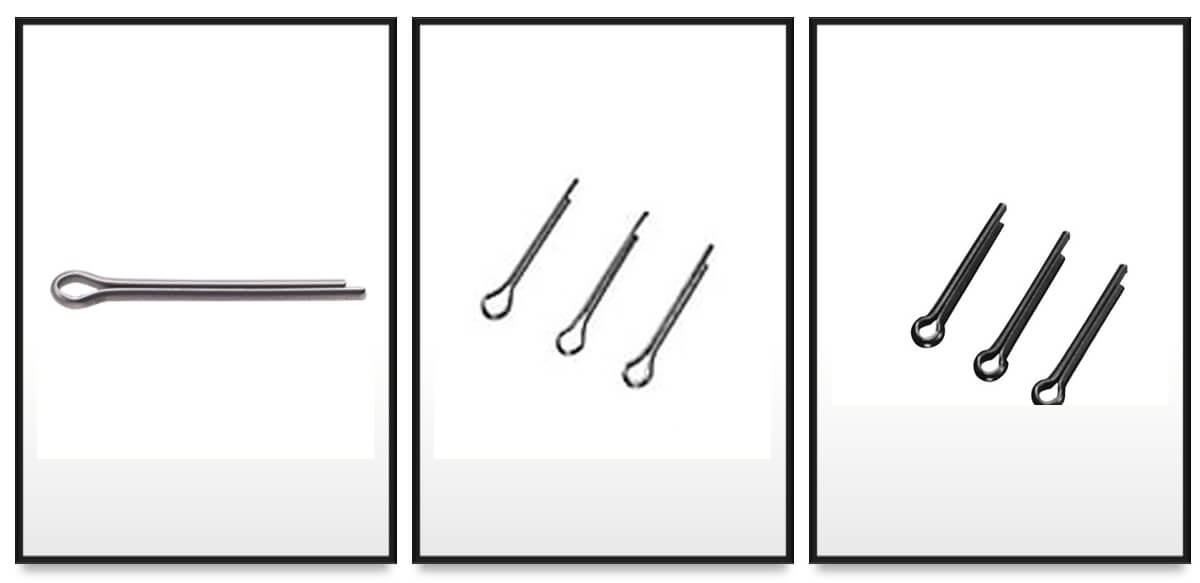
Despite its simplicity, the cotter pin plays a critical role in many mechanical systems where reliability matters more than high clamping force. You’ll find cotter pins in everything from agricultural equipment and industrial machinery to automotive suspensions and steering linkages. They’re especially useful in applications where components need to be secured but also periodically disassembled, since removal requires only basic hand tools.
What is a Cotter Pin?
A cotter pin is a solid, one-piece metal fastener formed from a single length of wire that is bent back on itself to create two prongs. One end is usually rounded or looped to make insertion and removal easier, while the two legs are spread apart after installation to keep the pin from backing out. Once bent, the pin acts as a physical stop rather than relying on friction or torque to hold components in place.
Cotter pins are typically installed through a cross-drilled hole in a bolt, shaft, or pin, often in combination with a slotted or castellated nut. After the nut is tightened to the required position, the cotter pin passes through the aligned slots and hole, preventing the nut from rotating further in either direction. This makes the fastening method highly resistant to vibration and cyclic movement.

How Does a Cotter Pin Work?
A cotter pin works by mechanically blocking movement rather than clamping parts together. After a fastener or pin is set in its final position, the cotter pin is inserted through a pre-drilled hole that intersects the axis of rotation. When the two legs of the pin are bent in opposite directions, the pin becomes locked in place and cannot slide back out along the same path.
Once installed, the cotter pin interrupts any potential rotation or axial movement of the secured component. If the fastener attempts to loosen due to vibration, shock loading, or repeated motion, it is physically stopped by the pin contacting the surrounding hardware. This direct interference is what makes cotter pins especially dependable in dynamic assemblies where torque-based locking methods alone may not be sufficient.

Parting Thoughts
MISUMI USA carries a wide range of industrial manufacturing components – including Cotter Pins – for your next project or machine fix. If you have any questions about measurement or sizing for your AWG needs, feel free to connect with our product experts, and engineers. Also, if you are looking for more insights be sure to check out our other blog articles, including: Bolt Grades Chart, Torque Specs For Bolts, and More.
Author: Scott Bredemann | Updated: 1/14/2026
Disclaimer:
The content on this webpage is for informational purposes only. MISUMI makes no guarantees, expressed or implied, regarding the accuracy, completeness, or validity of the information. Performance parameters, tolerances, designs, materials, or processes should not be assumed to reflect third-party suppliers’ or manufacturers’ deliverables within MISUMI’s network. Buyers are responsible for specifying their part requirements.
