

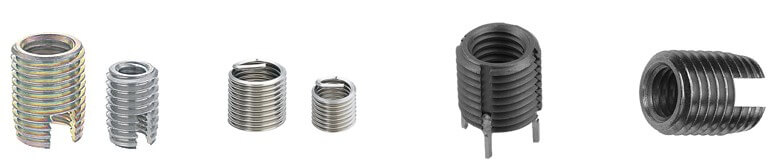
Helicoils, which is a type of helical wire insert, are commonly used both to repair damaged threads and to strengthen threaded connections in materials that are more likely to wear over time, such as aluminum and other softer metals. Once installed, the insert provides a durable threaded surface that matches the original fastener size. Understanding what a Helicoil is, can help determine whether it is the right solution for a repair.
Browse Threaded InsertsWhat is a Helicoil?
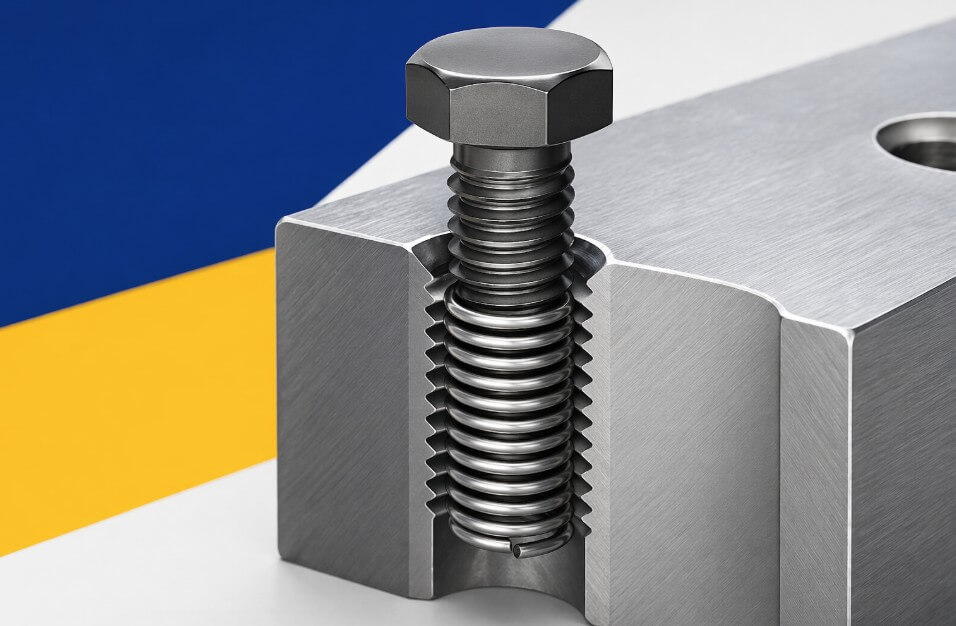
A Helicoil is a precision-formed helical coil of metal wire that is designed to act as an internal thread insert. Rather than being a solid bushing, it has a spring-like structure that follows the shape of screw threads. When installed into a properly prepared hole, it becomes the threaded interface that accepts the bolt or screw.
In practical terms, a Helicoil is a thread insert system used when a standard tapped hole alone is not the best long-term solution. Its purpose is to create a dependable set of internal threads inside another material, especially in situations where thread performance, fit, and service life matter.
How a Helicoil Works
During installation, the insert follows the newly cut threads in the parent material and locks into place as it is seated. Its outer surface grips the tapped hole, while its inner surface is sized to match the original fastener. This lets the repaired or reinforced hole accept the same thread size that was intended for the application.
A small driving tang at the end of the insert is typically used to turn it into position. After the insert is installed to the correct depth, that tang is usually broken off so the fastener can pass through normally, if the application requires it. Once that is done, the bolt or screw threads into the insert just as it would into a standard threaded hole.
Common Applications for Helicoils
| Application Area | Uses |
|---|---|
| Equipment Maintenance and Repair | Restore damaged threaded holes in housings, covers, brackets, and mounting points so parts can return to service without changing the original fastener size. |
| Automotive Applications | Engine components, transmission housings, spark plug threads, brake system parts, and accessory mounting points that face heat, vibration, and repeated servicing. |
| Aerospace Components | Lightweight metal parts and assemblies where secure threaded connections, low weight, and long-term reliability are especially important. |
| Industrial Machinery | Machine covers, guards, fixtures, tooling plates, frames, and mounting surfaces that may be disassembled regularly for inspection or maintenance. |
| Electronics Enclosures | Smaller fasteners and compact components require a more durable threaded connection than the base material can provide on its own. |
| Precision Instruments | Assemblies where thread quality, repeatable fit, and reliable fastening matter in smaller or more delicate components. |
| Mechanical Assemblies | Broad range of assemblies where threaded holes are exposed to repeated use, service removal, vibration, or demanding operating conditions. |
Materials That Commonly Use Helicoils
- Aluminum — Commonly uses Helicoils because it is lightweight and easy to machine, but its threads can wear or strip more easily under repeated use.
- Magnesium — Often paired with thread inserts in applications where reducing weight is important but thread durability still needs to be maintained.
- Lightweight metal alloys — Frequently use Helicoils when the base material does not provide enough long-term thread strength on its own.
- Cast aluminum — Can benefit from Helicoils because cast parts may need added thread reliability in service or maintenance applications.
- Cast iron — Sometimes used when damaged threads need to be restored or when thread performance in a casting is a concern.
- Some plastics — Used in applications where direct threads in the material would wear too quickly or fail under load.
- Some composite materials — Can require inserts when a stronger and more stable threaded connection is needed than the base material alone can provide.
- Other softer engineering materials — Used where thread wear, pullout, or repeated assembly could shorten the life of a standard tapped hole.
Parting Thoughts
MISUMI USA carries a wide range of Inserts, including – threaded inserts, tangless inserts, insert tools, and more. If you have any questions about fastening concerns for your next project or fix, please feel free to contact our product experts, and engineers. For more insights about thread inserts/helicals, and other manufacturing related articles be sure to check out our blog, and articles like – Helicoil vs. Threaded Insert, 7 Tips for Using Helicals, 5 Facts About Helicals, and more.
Disclaimer:
The content on this webpage is for informational purposes only. MISUMI makes no guarantees, expressed or implied, regarding the accuracy, completeness, or validity of the information. Performance parameters, tolerances, designs, materials, or processes should not be assumed to reflect third-party suppliers’ or manufacturers’ deliverables within MISUMI’s network. Buyers are responsible for specifying their part requirements.