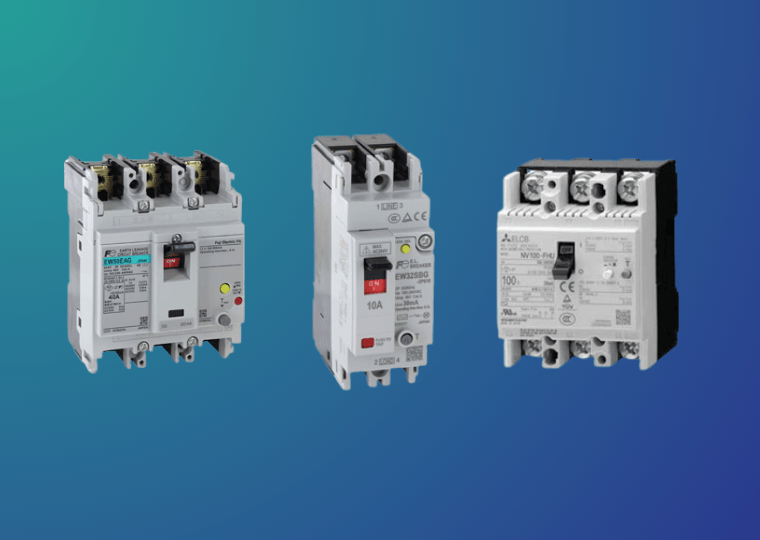

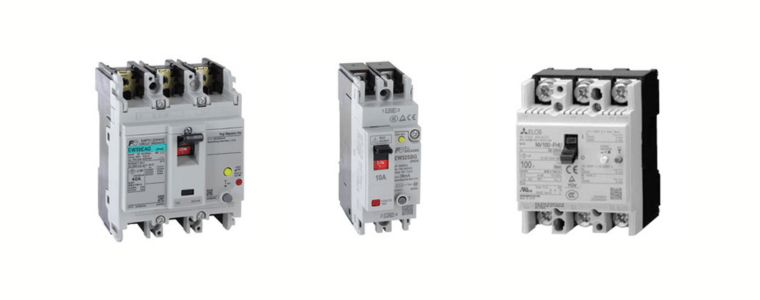
An earth leakage circuit breaker (ELCB) is a critical safety device used in electrical systems to prevent electric shock and electrical fires by detecting leakage currents to the ground (earth).
Earth leakage is an unintended state where electrical current is leaking from an electrical appliance or circuit to earth (ground). ELCBs are used to protect people and equipment from electrical shocks and against fire risks due to current leakage.
An ELCB automatically disconnects the electric circuit when it detects that the current flowing to the earth exceeds a pre-set value. This leakage could be due to insulation failure, faulty appliances, or accidental contact with live parts.
They fall into two types: Current Sensing Breakers and Voltage Sensing Breakers.
Current Sensing Breakers
The most common type of earth leakage circuit breaker in use now is the current sensing breaker or residual current circuit breaker (RCCB). They monitor the difference between current flowing through the phase and neutral wires. An imbalance between phase and neutral causes the breaker to trip, protecting against potential hazards like accidents, fire, or equipment damage.
Current sensing breakers consist of a current transformer with two primary windings and one secondary winding acting as the sensing coil. The primary windings support the phase and neutral wires. When the current flowing through the phase and neutral are equal they create opposing magnetic fields and no current flows through the sensing coil. When there is earth leakage the magnetic fields are not in balance, generating a current through the secondary winding thus causing the breaker to trip.
Current Sensing Breakers Advantages
- Can detect any earth fault whereas voltage sensing only detects faults in the main earth connection.
- Can detect changes in phase and neutral currents.
- Are efficient and inexpensive.
- Require fewer connections than voltage sensing breakers.
Current Sensing Breakers Disadvantages
Current sensing breakers have the disadvantage of nuisance tripping when an electric load suddenly changes and some current goes to earth despite there being no risk of shock.
Voltage Sensing Breakers
Voltage sensing breakers are older and less commonly used now than current sensing breakers. Voltage sensing breakers require a ground connection, unlike current sensing breakers which do not require this connection, to measure earth leakage. They contain a trip coil that senses voltage.
During normal operating conditions, there will not be voltage across the trip coil. When an earth fault occurs, such as line voltage contacts the metal enclosure of the protected device, voltage will cross the trip coil causing the breaker to trip. This protects the equipment and anyone who comes in contact with the electrical devices.
Advantages of Voltage Sensing Breakers
Compared to current sensing brakers, they offer a couple advantages:
- Less sensitive, resulting in few nuisance trips
- Can be less expensive
Disadvantages of Voltage Sensing Breakers
While still in use, voltage sensing earth leakage circuit breakers are generally not used in new projects due to their disadvantages.
- They require extra connections between the source and the breaker.
- Any wiring breaks to earth or live current generates a failure which could result in severe shock hazards to people.
- Other devices connected to the earthing system can generate voltages that cause the breaker to trip.
- They do not provide shock protection if the line conductor is touched.
Earth Leakage Circuit Breakers vs Molded Case Circuit Breakers
The primary difference between ELCBs and MCCbs is that ELCBS protect people from shock and fire hazards whereas MCCbs protect equipment form overloads and short circuits.
| Feature | ELCB | MCCB |
| Main Purpose | Earth leakage protection | Overload & short circuit protection |
| Protection For | People & fire | Equipment, wiring, fire |
| Sensitivity | 10–100 mA | 15–2500 A |
| Detects Leakage? | Yes | No (unless equipped with ELB) |
| Detects Overload? | No | Yes |
| Detects Short Circuit? | No | Yes |
| Typical Use | Residences, offices | Industrial, commercial, large loads |
| Resettable? | Yes | Yes |