A tool balancer is a mechanical suspension device that is used to hold tools above workstations in manufacturing settings. They reduce operators’ physical fatigue by keeping the tools in a consistent position and literally taking the weight off their shoulders.
Tool balancers also aid in greatly reducing muscle strain and injuries that can arise due to repetitive motions.
Overview: Spring Tool Balancers
The common types of tool balancers are spring, electric, electro-pneumatic, and pneumatic. We will focus on the spring type.
Spring type tool balancers have an internal coiled spring that minimizes the weight of a tool. This spring has a locking mechanism that allows for the tool to “float” weightlessly, which can be achieved from the pressure put on the spring. This makes it easier to lift and maneuver during use.
These tool balancers feature a retractable cable that can be extended, shortened, or set in a stationery position. They typically have a weight capacity of 1 to 40 lbs, although there are some heavy duty models that can support higher weights. These are best used for lighter electric and pneumatic tools in applications that require speed and accuracy.
Structural Breakdown of a Tool Balancer
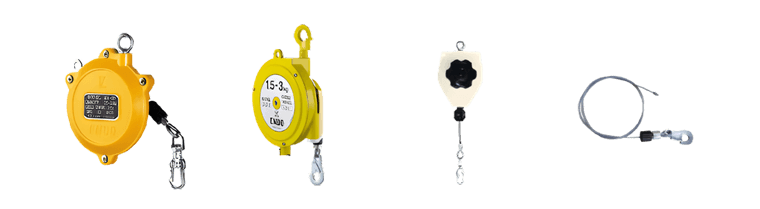
The mechanics of a tool balancer might seem simple, but there is a lot of elements that make up the overall structure of the tool, as you can see from the image of a Endo Kogyo Tool Balancer below:

Let’s go over some of the critical parts of a spring tool balancer:
Cable: Used to suspend the tool or object, linking it to the spring. They can be made of metals or synthetic fiber material. Cables can be worn down due to fraying and other signs of frequent use. They can be replaced without needing to purchase an entirely new unit.
Housin: Outermost casing, made of either plastic or metal.
Internal Coil System: Automatically adjust tension to support the load and keeps the object suspended. Its structure of a tool balancer is based on a pulley mechanism.
Worm: Threaded screw that can be adjusted to increase or decrease the tension inside the internal coil. Can be adjusted manually or with a screwdriver.
Top Hook: Attached to the housing; this secures the tool balancer to a mount or frame.
Bottom Hook: Attached to the cable, which attaches to the tool.
Factors to Consider when Choosing a Tool Balancer
There are a lot of options for various applications, which can make the choice difficult. Here are some factgors to consider when choosing the right tool balancer.
Weight and Size: Choose a balancer that can accommodate for the tools’ sizes and dimensions.
Length of Cable: Select an appropriate cable length that allows the tool to reach all required work areas without excessive slack.
Adjustability: Ensure the balancer can be easily adjusted to the desired lengths and tension.
Environment: Consider factors such as dust, moisture, temperature, and corrosion that may affect balancer performance and durability.
Find the Right Tool Balancer at MISUMI
Choosing the right tool balancer enhances workplace ergonomics and efficiency by significantly reducing operator fatigue, leading to safer and more productive manufacturing environments.
MISUMI carries a line of tool balancers, including spring-types by Endo Kogyo. Advantages include:
- Improving working efficiency and reduce worker fatigue
- Improve tool stability and allow for precise maneuverability
- Help reduce wear and product damage