
Transformers!
You’ve seen them everywhere, even if you aren’t aware of their presence. From massive power substations to the smallest of consumer devices, power transformers serve a critical role in power delivery and regulation, and industrial automation is no exception.
This article takes a deep dive into how these devices work, and how you can leverage the benefits they provide when designing your next automated line.
Article Summary
Transformers enable efficient power distribution and flexible voltage standards in industrial automation by converting voltages up or down while providing galvanic isolation. High voltage minimizes transmission losses, while low voltage supports fast, low-power signaling; transformers reconcile these needs via turns ratios that trade voltage for current with minimal losses.
They operate through electromagnetic induction between primary and secondary coils, keeping power approximately constant across both sides. In practice, step-down units feed control cabinets and PLCs, while step-up units serve heavy machinery that requires higher voltages.
Voltage Overview
Before we start looking at why transformers are so important, it may help to go over some basic electrical theory. Electrical current (I) is expressed as the total change in electrical charge (ΔQ) divided by time in seconds (t). In other words, the more electrons moving through a conductor at a given time, the higher the measured current will be.
This value is often a major limitation in power transmission, as running circuits with high currents will often lead to energy loss in the form of heat. Beyond being inefficient, excessive heat loss can potentially damage the conductors, forcing repair or replacement. How can we deliver a lot of electrical power (P) without cooking the transmission lines delivering it? To solve this, we’ll need to look at how electrical power is calculated.
Power delivery in electrical terms can be defined as electrical current multiplied by the voltage (V). But what is voltage? Within a circuit or conductor, voltage is measured as the difference in electrical charge between two points. (This difference in charge is actually what incites electrons to move, as they attempt to create a neutral distribution of charge through a circuit.) By increasing the difference in charge, we can transmit an equivalent amount of power at a lower current, while reaping the many benefits of more efficient transfer.
High voltages are great for power delivery, but here’s the catch: they’re awful for data/signal transmission. As I mentioned in the previous blog post about physical layers, it would take more power to send data at a higher voltage than a lower one, assuming current is kept the same.
What’s more, it is comparably slower, as it takes longer for a signal at +240V to fall back to zero than it would if it had started at +24V. This could greatly limit the effectiveness of devices that need to send data hundreds or thousands of times a second.
The factory builder faces a challenge: high voltages are best for power transmission, crucial for supplying power to numerous devices that need significant electricity. However, devices like sensors send data at lower voltages in order to operate at high frequencies while using minimal amounts of power. The builder cannot standardize all equipment on one set voltage level without compromising on power efficiency somewhere in the facility.
So, what are they to do? This is where transformers come in. These devices take an input voltage and either increase or decrease it, allowing for different voltage standards to be used within a system or facility.
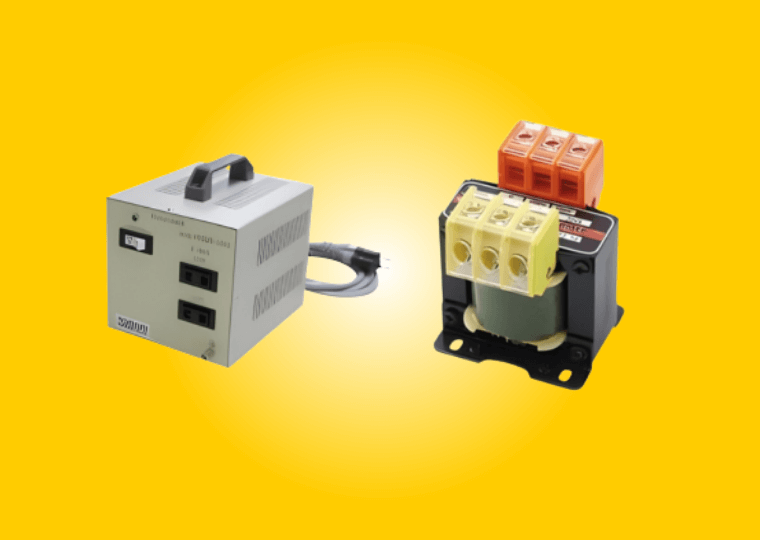
For example, a facility distributes power via high voltage to control cabinets containing a transformer, which steps the voltage down to levels that can be used by the PLC components inside.
How Power Transformers Work
Transformers typically consist of two coils of wire next to each other but NOT physically connected. The input side is referred to as the primary coil, while the output side is called the secondary coil. Each coil has a different number of windings (N), or loops of wire.
When current goes through the primary coil, current is induced via electromagnetic induction on the secondary coil. The voltage/current on either coil changes depending on the ratio of windings (n) between the primary and secondary coils, though total electrical energy remains the same (with some loss due to resistance).
The following equation is used to determine voltage change across a transformer:
As you can see, the voltage change between the primary and secondary coils is directly proportional to the ratio of primary coil windings to secondary coil windings. Again, it is important to remember that because power is equal on both sides, the coil with lower voltage will have a higher current.
Deriving the equation for electrical power in terms of primary and secondary voltage/current (equation 2) gives us the following:
Equation 4: Power between Primary and Secondary Transformer Coils
How They’re Used
The combination of decreased voltage and increased current on the secondary coil can be advantageous when applied correctly. I alluded to this previously, where I suggested that power can be delivered to a control cabinet at a high voltage, then converted to a lower voltage for distribution to components within the cabinet.
Depending on the setup, the increased current could be beneficial for components set up in parallel, as the simultaneous current draw from several components would necessitate it. For these purposes, you would want to look for a step-down transformer.
Step-up transformers exist as well, and they perform opposite to step-down transformers — that is, they take a voltage on the primary coil and increase it on the secondary coil (while also decreasing the output current). These types of transformers are sometimes connected to heavy machinery in lieu of a direct connection to the power distribution line, where even the higher voltages provided by the main power distribution line are not enough.
It’s worth mentioning here another key benefit of transformers — because the coils within them are not physically connected, they can be used to provide some electrical isolation from other components, thus potentially preventing unwanted electrical discharge. Isolating components becomes increasingly important when dealing high voltage power transmission, where unwanted electrical discharges can (and often are) lethal.
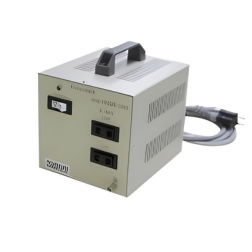
We hope this article has given you a clearer picture of how transformers function, why they matter, and how they operate in an industrial automation setting. You can find transformers and other great electrical products here.