


AI is essential for staying competitive. But how it’s deployed will be the ultimate factor in speeding up the design process and reducing costs. Think about the hours engineers spend chasing quotes, following up on orders, or vetting new suppliers. AI has the potential to eliminate some of the most resource-heavy challenges that engineering teams face.
Fictiv’s 2026 Manufacturing and Supply Chain report dives into how manufacturing and supply chain leaders feel about AI, how it’s being implemented, and the potential that AI has for empowering engineering teams throughout the design cycle.
The report covers everything from supply chain management challenges to sustainability. But for today, we’re going to dive deeper into the AI adoption findings.
Let’s get to it!
AI is Essential for Staying Competitive
95% of manufacturing and supply chain leaders say AI is a requirement and 97% surveyed say AI is already embedded across manufacturing and supply chain workflows.
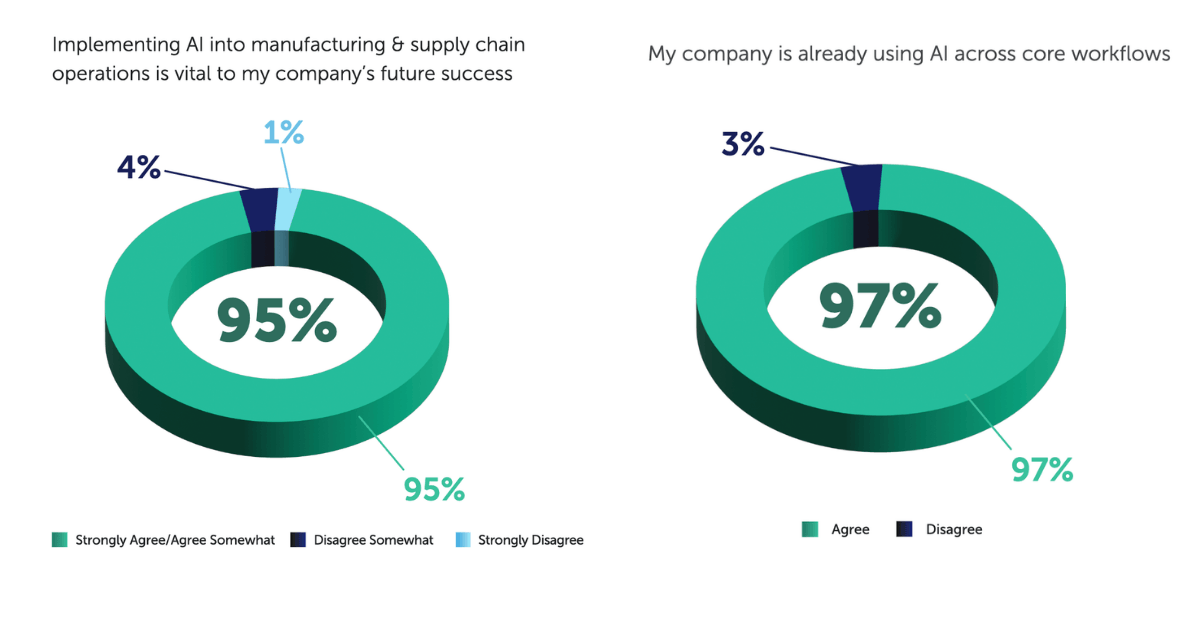
AI is primarily being used to augment the engineering workflow rather than replace specialized manufacturing expertise. It’s been shown that AI can handle the repetitive, data-heavy, and administratively burdensome work, so that engineers can focus more time on the design process and get to production faster.
This is important for engineering teams to keep in mind as they navigate the AI era and learn how to best approach it in their design workflows. The highest-value applications depend on where your team feels the most operational pain.
If your team is struggling to identify the best approach to implementing AI, the best questions to ask are:
- Is AI deployment concentrated in the right workflows?
- Is it actually closing the loop from prototype to production?
AI is Expected to Offer Significant Productivity Gains
A majority of manufacturing and supply chain leaders believe AI will drive 50% or more in productivity improvements. Many teams are now targeting 2-5x improvements in how fast and reliably they can build.

Engineering teams will see the fastest improvements by combining AI with workflow redesign across the design cycle.
Dropping an AI tool into a broken or fragmented workflow won’t improve productivity. It’s critical to evaluate how the current design cycle functions and identify where AI can make the biggest impact.
When it comes to product development specifically, the data points to two areas where AI is having the greatest effect:
- Quality control and inspection (49%)
- Design for Manufacturability, or DFM (39%)
This is particularly relevant for engineering teams. Quality issues and late DFM surprises are among the costliest and most schedule-disrupting problems a team can face. AI that strengthens inspection feedback and flags manufacturability risks earlier in the development cycle means teams catch problems before they become costly.
Investing in AI that improves inspection quality and tightens DFM feedback loops is part of an overall risk reduction strategy that protects schedules, reduces rework, and ultimately gets better products to market faster.
Save time, sharpen your strategy, and avoid falling behind. Download the 2026 State of Manufacturing and Supply Chain report.

Survey Methodology and Respondent Profile
The 2026 State of Manufacturing and Supply Chain report is based on a survey of 321 director-level and above manufacturing leaders across production, engineering, supply chain, R&D, and digital innovation, with strong representation from mid-to-large companies and key sectors like MedTech, Climate Tech, EV, and Robotics. It tracks trends from 2020–2026, with especially reliable year-over-year comparisons between 2025 and 2026 due to a consistent respondent profile.


