


Shock absorbers are commonly known for their use in automotive industries – they are hydraulic devices that control and dampen the movement of a vehicle’s suspension springs. But they are also used in heavy machinery, material handling, robotics, and various industrial automated systems.
Does your application need a shock absorber? This article provides information on how to choose the right one.
What does a shock absorber do?
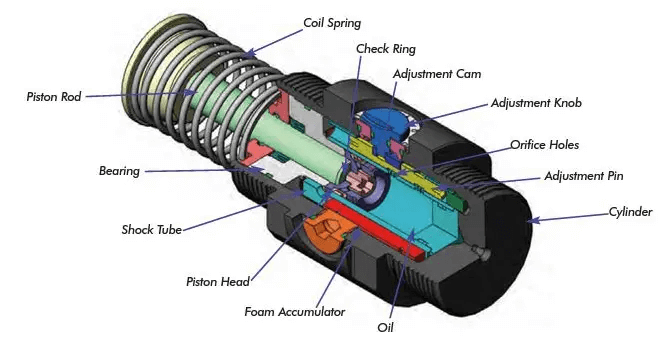
The job of a shock absorber is to keep machinery safe. It works by converting kinetic energy of a load into heat, which is dissipated into the atmosphere. When an object collides with the piston rod, the piston is pushed down into the pressure chamber which forces oil out of the orifices, and the oil then moves into the accumulator.
It is most common in automotive, in which the shock absorber’s main purpose is to help cushion vehicles when driving on uneven roads. In industrial applications, they are mainly used for extending machine life as well as:
- Boosting production quality
- Reducing noise
- Allowing for higher operation speeds
- Safer machine operations
The main components of a shock absorber are the cap, piston rod, piston, accumulator, inner tube, orifice, and pressure chamber.

Fixed vs. Adjustable Shock Absorber
The differences between fixed versus adjustable shock absorbers depend on how their damping characteristics are set and how much tuning flexibility they offer.
Fixed
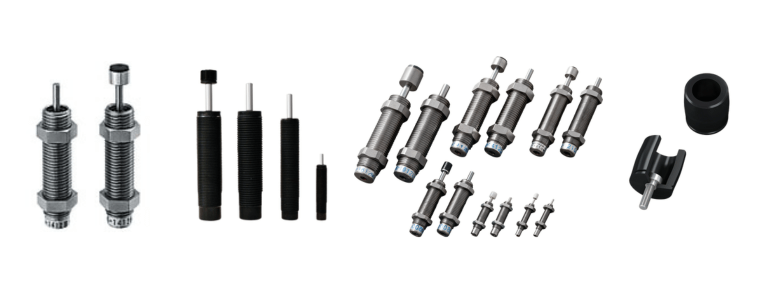
Fixed shock absorbers are used for a specific load range and when the impact parameters are predetermined and don’t change. They are the least expensive, offer consistent performance, and are tamper-proof.
Adjustable
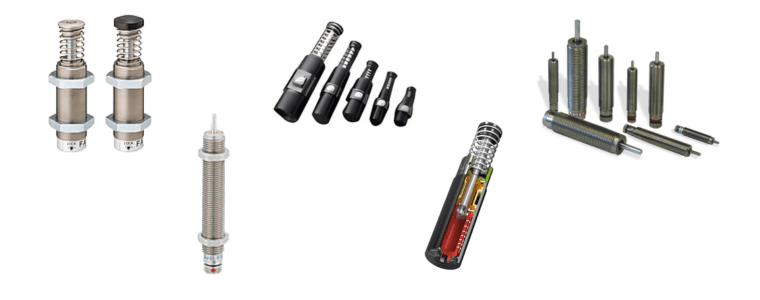
Adjustable shock absorbers allow resistance to be changed after installing to meet operation conditions. This can be done in several ways including:
- Adjustable orifice valving (mechanically tuning fluid flow)
- Self-regulating valves that automatically respond to velocity or load changes
- More advanced electronic or semi-active systems that use sensors and control units to adjust damping in real time
Besides having versatility across conditions (such as varying loads and speeds) adjustable shock absorbers can help reduce maintenance and improve performance and efficiency.
Enidine, a manufacturer of shock absorbers (available at MISUMI) offers great information on how to correctly and safely adjust a shock absorber.
Single vs. Multiple Orifice Shock Absorbers
“Single-orifice” vs. “multiple-orifice” refer to how hydraulic fluid is regulated inside a shock absorber as it is compressed and how the damping force is generated and distributed over the stroke.
Here is an overview of single versus multiple orifice shock absorbers and when to use them.
Single
Single-orifice shock absorbers have one primary fluid passage (orifice) through which oil flows as the shock is compressed. This orifice area can be changed by turning an adjustment knob that alters the clearance of an adjustment ball. This changes the effective damping force, where higher restriction increases force and lower restriction decreases it.
The single orifice produces constant orifice area damping, meaning the damping force is largest at the beginning of the stroke when impact velocity is highest, and this type of design can deliver high-energy absorption in a compact package.
Single orifice is often chosen when compact size and high initial force are priorities, and when adjustability is needed mainly for tuning magnitude.

Multiple
Multiple-orifice shock absorbers have several fluid passages (orifice holes) arranged in the shock tube. The adjustment knob and an internal cam/pin mechanism open or close these holes, which changes the total orifice area and thus the damping force.
Because there are multiple holes that can be individually engaged or restricted, the damping force can be spread more evenly or linearly over the stroke, known as “conventional damping.” This provides a more uniform or linear shock force over the entire stroke and allows the most energy to be absorbed for a given stroke length. Adjustable multiple-orifice units let you tune this more efficient, smoother damping to match varying input conditions.
A multiple orifice is selected when you want more efficient, linear deceleration across the stroke and the ability to handle a wider range of operating speeds or impact energies.
Sizing Your Shock Absorber
To size your shock absorber, four key properties of the application are needed:
- Mass
- Velocity
- Propelling force
- Cycles per hour
Then calculate energy from motion:
- For horizontal motion, calculate kinetic energy using:
Eₖ = ½ × M × V² - For vertical motion, include gravitational potential if applicable:
Eₖ = M × g × h - If a propelling force acts during the travel, calculate work energy:
Eₓ = F × stroke (shock absorber stroke)
Lastly, determine the Total Energy per Cycle by adding the kinetic and work energy to find the total energy per impact cycle. Then multiply by the number of cycles per hour to get the total energy per hour the absorber must handle.
For a deeper dive on how to correctly size your shock absorber, click here.
Mounting Options for Shock Absorbers
Poor mounting can lead to bending and dramatically reduce life, so it’s critical to mount a shock absorber correctly.
All shock absorbers must be bolted rigidly to a non-flexing mounting structure. There are few different mounting orientations, depending on the application including:
Rod Up
Rod up orientation entails the piston rod is oriented upward and the body downward. Using this orientation reduces contamination at the rod seal and protects from damage and corrosion. This is typically used in industrial machinery, conveyors, automated systems, and any time of machinery or equipment used in an environment with dust or debris.
Rod Down
Rod down refers to the piston rod oriented downwards and the body upwards. This mounting option is sometimes preferred when space constraints dictate the orientation. However, it can increase exposure to contaminants and increase wear faster.
Horizontal Mounting
Horizontal mounting is efficient for compact machine layouts where vertical space is limited. It is typically seen in machine tool slides, robotic axes, and packaging equipment. When choosing this orientation pay close attention to lubrication and alignment. Horizontal mounting increases the likelihood of misalignment, and it’s possible for oil to pool along the lower side of the cylinder.
Common Mounting Mistakes
For industrial machinery specifically, mount brackets must be stiff enough to avoid flexing, fatigue cracking, and loss of damping effectiveness under repeated impact loads.
When choosing mounting accessories, it’s important to choose the appropriate mount interfaces (eye, clevis, trunnion) and bushings or spherical bearings to accommodate unavoidable misalignment while maintaining load capacity.
Other mounting mistakes to avoid include:
- Side loading the shock
- Using soft brackets with stiff dampers
- No bump stops
- Over-tightening elastomer bushings
- Ignoring mounting angle effects
- Assuming any orientation works
For further information, here are a couple common mounting challenges and how to solve for them.
MISUMI offers a wide range of shock absorbers for your industrial automation needs, including top brands such as Ace Controls, Enidine, SMC and more. In addition, we also carry various accessories that can be used when mounting shock absorbers such as mounting blocks and side load adapters.


