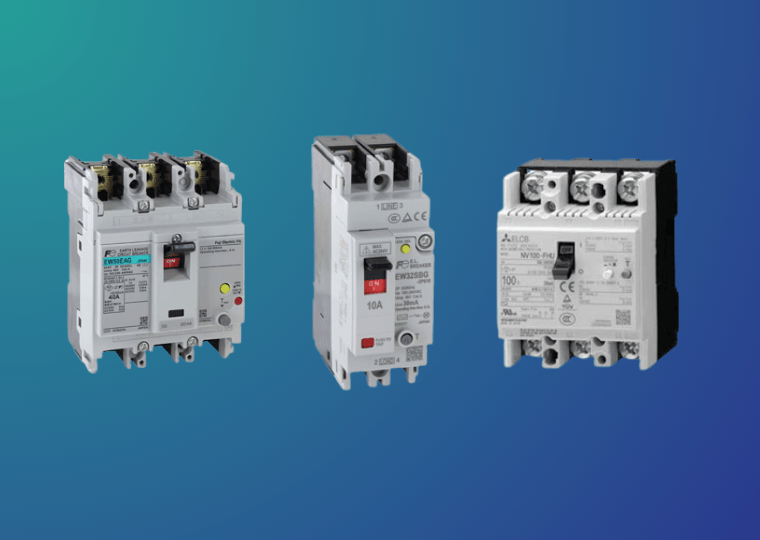
Circuit breakers are a core component found in every control cabinet. While their purpose is straightforward, finding the best one for your system can be difficult in the face of so many models.
I’m going to dive into the basics behind circuit breakers, including the terminology, the various standards for circuit protection, and the different types.
Circuit Breakers Terminology
Here are some common terms used to define a breaker’s operating specifications.
Rated Current
Rated current is the maximum current at which the breaker is designed to operate at in normal conditions. It is also known as the nominal current. Said “normal operating conditions” are defined by the breaker manufacturer but usually include specifications for operational time and temperature.
Trip Current
Trip current is the current at which the breaker trips (cuts off connection). It is sometimes referred to as block capacity. This is a separate value to rated current. It is possible for a breaker to experience an inrush current higher than its rated current without tripping; this often happens when turning on an electrical motor or other devices that draw a lot of power. However, the moment the current exceeds the trip point, the breaker will trip to protect any connections downstream.
Ampere Frame
Ampere frame is a general term used to describe a breaker’s capability in handling electrical currents. It is often associated with the physical dimensions of the breaker itself. The unit used, AF, corresponds to the trip current of the breaker, though this is not necessarily equivalent; an 125AF breaker could have an adjustable range of trip currents from 60A to 125A.
# Electrodes/Poles
This value indicates the number of connection points on the breaker itself. For example, a 3-pole breaker will have six connections total, while a single-pole breaker will only have two.
Circuit Breaker Types
Now that we’ve gone over the basic terminology, we can dig deeper and examine the different types of circuit breakers available.
Molded-Case Circuit Breakers
Molded-case circuit breakers (MCCBs) are generally equipped with two methods of overload protection, those being thermal and electromagnetic. The thermal protection consists of contacts that normally touch and conduct current through the breaker.
However, a current that exceeds the tripping point will cause the contacts to overheat and deform, separating them and breaking the connection.
Electromagnetic protection works on a similar principle. Rather than overheating components within the breaker triggering the cut-off, the trip current generates a magnetic field, which then activates a mechanism that disconnects the contacts.

Miniature Circuit Breakers
The next type of circuit breaker worth mentioning are miniature circuit breakers (MCB). As the name may suggest, these breakers are often physically smaller than their bigger molded-case counterparts. They also generally operate at lower-rated currents and have lower trip currents as well.
While a “weaker” circuit breaker may not seem like a good thing, MCBs are designed for residential/domestic environments, where having a lower trip current may be desirable. Molded-case circuit breakers may be ineffective at protecting against lower current spikes that can then wreak havoc on your electrical devices.

Earth-Leakage Circuit Breaker
These methods are fine for short circuits, but what about a floating/leaking earth? For that, you would want to look for a dedicated earth-leakage circuit breaker (ELCB). Much like MCCBs, ELCBs protect your circuit in the case of a current overload. However, these devices feature an additional connection to a ground (earth) point. This point is used to monitor either the voltage balances between conductors, tripping when it detects a leakage or imbalance.

One major drawback with traditional earth-leakage circuit breakers is that they cannot protect against short circuits (such as someone touching a live wire or terminal) due to a requirement for tripping being current flow through the earth point.
As a result, ELCBs have fallen out of favor compared to residual-current circuit breakers (RCCB). RCCBs, like ELCBs, are also used to detect electrical issues, but do so by measuring the current going in and out of the breaker. Should the differences between these values become too great, the breaker will trip. Unlike ELCBs, these breakers do not necessarily require connection with a ground point to successfully trip.
This handy table breaks (haha pun) down the protections provided by the four types of circuit breakers I mentioned.
O = Yes, X = No
| Molded-Case | Miniature | Earth Leakage | Residual Current | |
| Abbreviation | MCCB | MCB | ELCB | RCCB |
| Short Circuit | O | O | X | O |
| Current Overload | O | O | O | O |
| Thermal Protection | O | O | X | X |
| Earth Leakage | X | X | O | O |
UL Certifications
There are two major UL certifications regarding circuit breakers, those being UL 489 and UL 1077. These certifications are given to circuit breakers that meet the requirements of protection. However, the requirements to achieve certification vary between the two.
UL 489 rated breakers are certified to be used as standalone circuit protection and can protect multiple devices downstream. These devices would be the ones directly connected to the power source within a control cabinet.
Conversely, UL 1077 rated breakers are only certified to protect one device within a cabinet, serving more as supplemental protection should the primary breaker fail.
A good rule of thumb is that a UL 489 rated breaker can be used in place of a UL 1077 rated breaker, but a UL 1077 cannot be used in place of a UL 489 breaker.
Finding the Right Circuit Breaker for Your Application
We’ve spent a lot of time discussing specs, now it’s time to find the perfect breaker for your next project!
Here are some useful things to consider when choosing a circuit breaker.
What is the operational environment?
For industrial settings, having a breaker with a higher rated current (and corresponding trip current) will let industrial machines operate normally without fear of accidentally tripping, all while providing protection when it does matter. Conversely, a residential setting may benefit from breakers with lower rated currents, so that your personal electronics can stay protected from the smaller overloads that may occur.
How much power is going through these breakers?
Most electrical sockets found in homes in the US operate at 120Vac. Having a 400AF breaker might not be able to adequately protect your electronics, especially if the trip current is not adjustable to lower levels. A 60AF breaker would be much more appropriate in this case. Conversely, that same 60AF breaker will regularly trip or even break if regularly exposed to a 480Vac source, which is not ideal in facilities where machines run 24/7!
Where is this breaker being connected to?
If this breaker is being used for primary current protection, or is connected to a device that draws a lot of power, you should look for a UL 489 rated breaker. Otherwise, a supplementary protection device will serve just fine. Similarly, a 3-pole or 4-pole breaker will enable easy protection of 3-phase power transmission within a cabinet but is unnecessary when transmitting power in the form of direct current.
Find the Right Circuit Breaker for Your System
There are a lot of circuit breakers on the market, each with their own specifications dictated by their manufacturers. Hopefully this article has provided the information necessary to make an informed decision on which circuit breaker would best fit your needs.
Remember to always read the relevant documentation before purchasing an electrical component, and work with qualified electricians/engineers when designing and installing components.
Click below to explore MISUMI’s entire selection of circuit breakers.