


“Universal design is the design of products and environments to be usable by all people, to the greatest extent possible, without the need for adaptation or specialized design.” -architect Ronald L. Mace. This design concept began in the 1950s in Europe, Japan, and the US to accommodate the vast array and number of people living with disabilities and even the increase in lifespans. Incorporating design concepts with consideration to elderly people and people with disabilities is one of the most important themes for ISO in creating international standards. By the 1980s, universal design went beyond providing to people with disabilities to being a normalized concept.
While the principles of Universal Design were founded under the need to provide for the elderly and people with disabilities, it evolved to fulfill an even greater need in the world, making everything usable to the greatest extent by anyone. After all, no person is the same. Universal Design is applied and adopted across multiple industries. The principles can be applied to a production facility and tools used in production lines as well. Following these guidelines can lead to a design that many customers will enjoy and even make their lives easier which is a true duty of an engineer. We hope you consider MISUMI components in your future designs!
The Seven Principles of Universal Design
(1) Equitable Use: The design is useful and marketable to people with diverse abilities.
Guidelines include: Provide the same means of use for all users. Identical whenever possible; equivalent when not. Avoid segregating or stigmatizing any users.
(2) Flexibility in Use: The design accommodates a wide range of individual preferences and abilities.
Guidelines include: Provide choice in methods of use. Accommodate right or left handed access and use.
(3) Simple and Intuitive Use: Use of the design is easy to understand, regardless of the user’s experience, knowledge, language skills, or current concentration level.
Guidelines include: Accommodate a wide range of literacy and language skills. Eliminate unnecessary complexity.
(4) Perceptible Information: The design communicates necessary information effectively to the user, regardless of ambient conditions or the user’s sensory abilities.
Guidelines include: Provide compatibility with a variety of techniques or devices used by people with sensory limitations.
(5) Tolerance for Error: The design minimizes hazards and the adverse consequences of accidental or unintended actions.
Guidelines include: Provide warnings of hazards and errors. Provide fail safe features.
(6) Low Physical Effort: The design can be used efficiently and comfortably with minimum fatigue.
Guidelines include: Allow the user to maintain a neutral body position. Minimize repetitive actions.
(7) Size and Space for Approach and Use: Appropriate size and space is provided for approach, reach, manipulation, and use regardless of user’s body size, posture, or mobility.
Guidelines include: Accommodate variations in hand and grip size. Provide adequate space for the use of assistive devices or personal assistance.
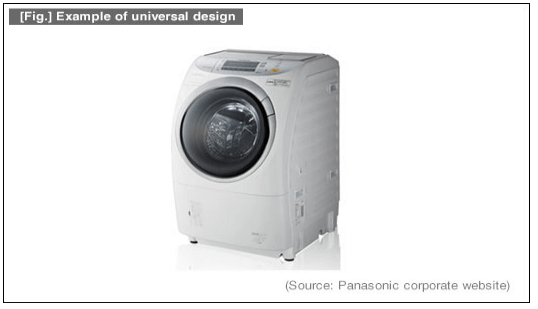
Shared Universal Design Terms
These terms and principles were founded around the same time as Universal Design with the increase of people with disabilities came to spotlight around the 1950s. These terms were the first terms in design used to bring equality to those with disabilities.
Accessible Design
The word “accessible” means approachable and easy-to-use.“Design with consideration to elderly people and people with disabilities” and “design in response to the needs of elderly people and people with disabilities” are adopted as a language used in the accessible design concept. However, the term “accessible” meaning approachable or easy-to-use does not target only elderly people and people with disabilities. This also refers to sophisticated designs that everyone can easily become familiar with.
Design for All
This literally means “designs for everyone”. It aims at creating user-friendly products, services, and systems, regardless of the user’s ability or situation. Prevalent in Europe, it is very close to the meaning and intent behind universal design.
Barrier Free Design
The concept of designing products, public services, buildings or environments, including commercial facilities and transportation systems, so that they are easily accessible to people with physical impairments. This is the fundamental concept of “barrier free” frequently used in building designs.
Inclusive Design
The term “inclusive” means that it includes everything in a comprehensive manner. These designs accommodate everyone’s needs. It requires design research toward creating a future market structure based on changes in demographics and the social involvement of people with disabilities.
“Universal design broadly defines the user. It’s a consumer market driven issue. Its focus is not specifically on people with disabilities, but all people. It actually assumes the idea, that everybody has a disability and I feel strongly that that’s the case. We all become disabled as we age and lose ability, whether we want to admit it or not. It is negative in our society to say “I am disabled” or “I am old.” We tend to discount people who are less than what we popularly consider to be “normal.” To be “normal” is to be perfect, capable, competent, and independent. Unfortunately, designers in our society also mistakenly assume that everyone fits this definition of “normal.” This just is not the case.” ‘ -Ronald L Mace
While Universal Design is not a new science and to many engineers, it is common sense but it takes a high level of attention to details to fulfill all of the principles for designs to be a success. Engineers love efficiency and can apply these principles to help the greater good of mankind.


