


The best repair method often depends on whether the damaged hole is in aluminum or steel. Aluminum threads are softer and more likely to strip, especially in parts that are assembled and disassembled often. Steel threads are stronger, but they can still fail from galling, rust, impact, or heavy service loads. A helicoil insert is one common type of thread repair insert, but solid inserts, key-locking inserts, and self-tapping inserts may be better suited depending on the material, load, vibration, and available wall thickness.
What Are Thread Repair Inserts?
Thread repair inserts are precision components installed inside a damaged or oversized threaded hole to create a new set of internal threads. Instead of relying on the weakened parent material,There are several styles of thread repair inserts, and each works a little differently. A helicoil insert uses a coiled wire form to rebuild the thread path. Solid inserts use a rigid sleeve with internal and external threads. Key-locking inserts use small locking keys to help keep the insert from rotating under load or vibration. In aluminum threads, inserts are often used to add durability to softer material. In steel threads, they are more commonly used to restore holes damaged by wear, galling, or corrosion.
Aluminum vs. Steel: Why the Material Matters
Aluminum is much softer than steel, so the internal threads can deform or pull out before the fastener itself is damaged. This is common when a bolt is over-tightened, removed and reinstalled many times, or used in a joint with limited thread engagement. In these cases, thread repair inserts can provide a harder, more durable thread surface while still allowing the part to remain lightweight.
Steel threads usually have higher strength, but they are not immune to damage. They can gall, seize, corrode, or become distorted under heavy loads. Steel also requires more force to drill and tap during repair, so proper alignment, cutting fluid, and tool selection matter more during installation.
Best Insert Type for Aluminum vs. Steel
| Insert Type | Best Use in Aluminum | Best Use in Steel |
|---|---|---|
| Helicoil Insert | Very common Good for repairing stripped aluminum threads while keeping the original fastener size. |
Useful for standard thread repair when the steel parent material is still in good condition. |
| Solid Threaded Insert | Good for higher-load aluminum applications or holes that will be assembled and disassembled often. | Good option Useful when the damaged steel threads need a stronger sleeve-style repair. |
| Key-Locking Insert | Useful in aluminum parts exposed to vibration, movement, or heavier service loads. | Often preferred Well-suited for steel threads in high-load, high-vibration, or critical repair locations. |
| Self-Tapping Insert | Good for softer materials Can cut its own external thread into aluminum and create a stronger internal thread. |
Can be used in some steel applications, but installation requires more force and proper tool control. |
| Heavy-Duty Insert | Used when aluminum threads are badly damaged or the repaired joint needs more load capacity. | Strong repair choice Used when steel threads are severely worn, oversized, or exposed to demanding loads. |
Common Aluminum Applications
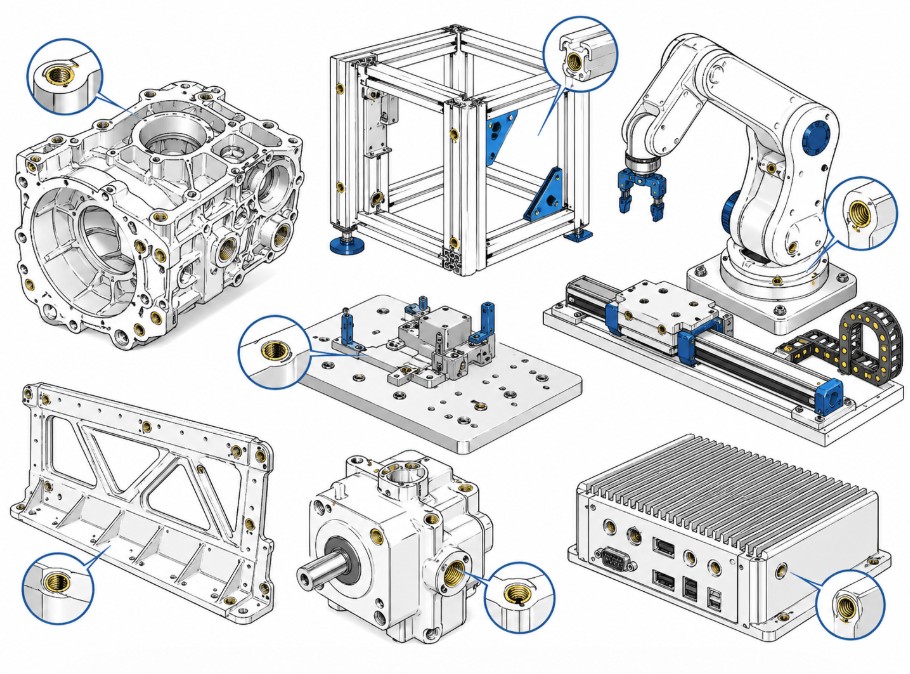
- Engine and transmission housings
- Specific examples: valve cover bolt holes, oil pan threads, sensor mounting holes, bellhousing threads, accessory bracket mounting points.
- Machine frames and automation equipment
- Specific examples: aluminum extrusion T-slot connections, sensor brackets, actuator mounts, guard panels, conveyor frame brackets.
- Fixture plates and tooling components
- Specific examples: clamp mounting holes, dowel-and-locator blocks, inspection fixtures, prototype tooling plates, modular workholding plates.
- Robotics and motion-control assemblies
- Specific examples: robot end-effector plates, linear rail mounting holes, gantry brackets, servo motor mounts, gripper mounting plates.
- Aerospace and lightweight vehicle components
- Specific examples: access panel screws, interior bracket mounts, lightweight frame members, battery enclosure threads, removable cover plates.
- Pneumatic, hydraulic, and pump housings
- Specific examples: pump cover bolts, manifold mounting holes, valve body screws, cylinder end-cap threads, regulator housing fasteners.
- Electronics and enclosure assemblies
- Specific examples: enclosure cover screws, PCB standoff holes, heat sink mounting holes, control panel fasteners, connector bracket mounts.
Common Steel Applications
- Tooling plates and fixture bases
- Specific examples: clamp bolt holes, locating block mounts, toe clamp threads, vise mounting holes, modular fixture grid holes.
- Dies, molds, and stamping components
- Specific examples: punch retainer screws, die shoe threads, stripper plate fasteners, wear plate mounting holes, mold insert screw holes.
- Heavy equipment and industrial machinery
- Specific examples: motor mount holes, gearbox mounting threads, equipment base plates, guard bracket holes, bearing housing fasteners.
- Automotive and vehicle repair
- Specific examples: suspension bracket threads, brake caliper mounting holes, frame bracket holes, seat mounting points, exhaust hanger threads.
- Maintenance and rebuild work
- Specific examples: stripped cover plate holes, access panel fasteners, worn service-port threads, equipment rebuild mounting holes, replacement part mounting points.
- Structural brackets and mounting plates
- Specific examples: support bracket threads, machine guard mounts, rail mounting plates, equipment anchor plates, welded bracket holes.
- Pipe, pump, and valve components
- Specific examples: pump casing cover bolts, valve body fasteners, flange cover threads, pipe support bracket holes, seal housing screws.
Considerations
One common mistake is choosing an insert that is too short for the load. A short insert may be fine for a light cover plate, but it may not provide enough thread engagement for a bracket, motor mount, tooling plate, or other joint that carries more stress.
Another mistake is using a light-duty insert in a high-vibration application. Vibration can loosen fasteners and place repeated stress on the repaired threads, so a locking insert or key-locking insert may be a better choice in those conditions. The condition of the parent material also matters. If the aluminum or steel around the hole is cracked, distorted, or too thin, the insert may not stay seated properly, even if it is installed correctly. It is also important not to treat aluminum and steel repairs the same way. Aluminum threads are easier to deform, while steel threads usually require more cutting force, better lubrication, and careful tool control.
Browse Threaded InsertsParting Thoughts
MISUMI USA carries a wide range of Inserts, including – threaded inserts, tangless inserts, insert tools, and more. If you have any questions about fastening concerns for your next project or fix, please feel free to contact our product experts, and engineers. For more insights about thread inserts/helicals, and other manufacturing related articles be sure to check out our blog, and articles like – What is a Helicoil?, Helicoil vs. Threaded Insert, 6 Quick Facts About Helical Coils, and more.
Author: Scott Bredemann | Updated: 4/29/2026
Disclaimer:
The content on this webpage is for informational purposes only. MISUMI makes no guarantees, expressed or implied, regarding the accuracy, completeness, or validity of the information. Performance parameters, tolerances, designs, materials, or processes should not be assumed to reflect third-party suppliers’ or manufacturers’ deliverables within MISUMI’s network. Buyers are responsible for specifying their part requirements.