


U-bolts are a pretty straightforward way to clamp a round, square, or odd-shaped part to something more rigid like a frame, or support rail. You’ll see them used in pipe supports, trailer frames, suspension assemblies, conduit runs, structural supports, and industrial equipment because they hold well without needing a welded or permanent connection. In a typical maintenance setup, a round U-bolt might be used to secure a hydraulic line to a machine frame, while a square U-bolt may be used to fasten a bracket around square tubing on a trailer or support stand.
What Is a U-Bolt?
Think of a threaded fastener formed in the shape of the letter “U,” that is essientially what a u-bolt is. Instead of having one straight shank like a standard bolt, it has two parallel legs with threads on the ends. Those threaded legs are typically inserted through holes in a mounting plate, bracket, or support surface and secured with nuts.
The main purpose of this is to create a mechanical clamp, so as the nuts are tightened, the U-bolt pulls the clamped part toward the mounting surface. This makes it useful in assemblies where a part needs to be held firmly but may still need to be removed, adjusted, or replaced later. They often times take the place of weld, or strap for part securing.
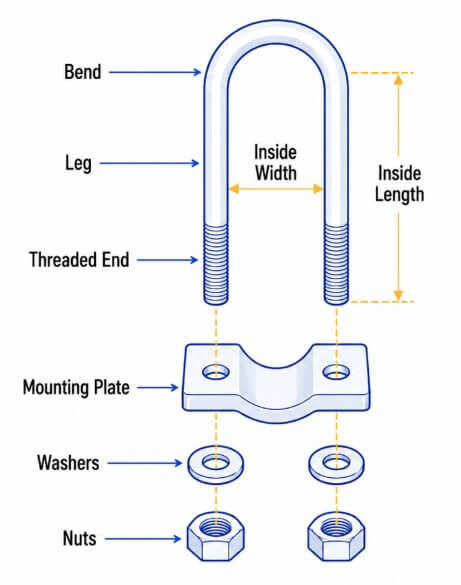
Basic Parts of a U-Bolt
- Bend: The curved or squared section that wraps around the part being held.
- Legs: The two straight sections that pass through the mounting holes.
- Inside Width: The distance between the legs, used to match the U-bolt to the part being clamped.
- Threads: The threaded ends where nuts are installed to apply clamping force.
- Nuts and Washers: Hardware used to tighten the U-bolt and help distribute load.
- Mounting Plate: A plate used to support the connection and keep the U-bolt aligned.
Common Applications for U-Bolts
| Application | When to Use | Common U-Bolt Material Used |
|---|---|---|
| Pipe and Tube Supports | Securing pipe, tubing, conduit, or fluid lines to a bracket, frame, wall, or support structure. | Carbon steel, zinc-plated steel, or stainless steel for wet or corrosive environments. |
| Trailer Frames | Attaching brackets, axle components, supports, or hardware around round or square frame members. | Zinc-plated steel, galvanized steel, or alloy steel for higher-load applications. |
| Suspension Assemblies | Clamping leaf springs, axles, or related components where a strong mechanical hold is required. | High-strength steel or alloy steel, often with a corrosion-resistant coating. |
| Conduit and Cable Runs | Routing and securing electrical conduit, cable trays, or utility lines along equipment, walls, or structural supports. | Zinc-plated steel for indoor use or stainless steel for outdoor and washdown areas. |
| Structural Supports | Fastening components to beams, posts, rails, or framing where drilling or welding may not be practical. | Carbon steel, galvanized steel, or stainless steel depending on load and exposure. |
| Industrial Equipment | Mounting guards, brackets, hoses, light fixtures, utility lines, or other removable components to machine frames. | Carbon steel, zinc-plated steel, or stainless steel for corrosion-prone equipment areas. |
| Marine and Outdoor Equipment | Fastening railings, brackets, dock hardware, supports, or equipment exposed to moisture or weather. | Stainless steel or galvanized steel for improved corrosion resistance. |
| Agricultural and Heavy Equipment | Securing brackets, supports, frames, implements, or replacement hardware exposed to vibration, dirt, and outdoor conditions. | Galvanized steel, zinc-plated steel, or alloy steel for heavier-duty use. |
Mistakes When Selecting or Installing U-Bolts
One of the most common U-bolt mistakes is choosing one that doesn’t fit properly. The U-bolt should sit cleanly around the pipe, tube, rail, or frame member without forcing it into position. If it is too tight, too loose, or the wrong shape, the clamp may still tighten, but it will not apply pressure evenly.
Sizing is another area to watch out for. A U-bolt that is too narrow can bind or sit crooked, while one with legs that are too short may not leave enough thread for proper nut engagement. Material choice matters too. Plain steel may be fine in a dry indoor setup, but outdoor, wet, or corrosive environments usually call for stainless steel, galvanized steel, or another protected finish.
When installing, over-tightening can crush thin-wall tubing or damage coatings, while under-tightening can let the part move and wear over time. On equipment that sees vibration, it is worth considering lock nuts, lock washers, thread-locking compound, or periodic inspection so the connection stays secure.
U-Bolts vs. Other Fastening Options
- Pipe clamps: Better for cushioning, spacing, or allowing some movement. U-bolts are better for a tighter, more rigid hold.
- Straps: Useful for light-duty holding or irregular shapes. U-bolts usually provide stronger, more direct clamping force.
- Brackets: Good for fixed mounting points. U-bolts work well when clamping around an existing pipe, tube, rail, or frame.
- Welded connections: Permanent and strong, but harder to change later. U-bolts are removable, adjustable, and easier to service.
Parting Thoughts
MISUMI USA carries a wide range of fasteners – including screws, bolts, nuts, threaded inserts, and more. If you have any questions about fastening concerns for your next project or fix, please feel free to contact our product experts, and engineers. For more insights about u-bolts, and other manufacturing related articles be sure to check out our blog, and articles like Industrial Fasteners Selection Guide, , U-Bolt Size Chart, and more.
Disclaimer:
The content on this webpage is for informational purposes only. MISUMI makes no guarantees, expressed or implied, regarding the accuracy, completeness, or validity of the information. Performance parameters, tolerances, designs, materials, or processes should not be assumed to reflect third-party suppliers’ or manufacturers’ deliverables within MISUMI’s network. Buyers are responsible for specifying their part requirements.


