

Author: Scott Bredemann
Updated: 5/7/2026 | Read Time: 8mins
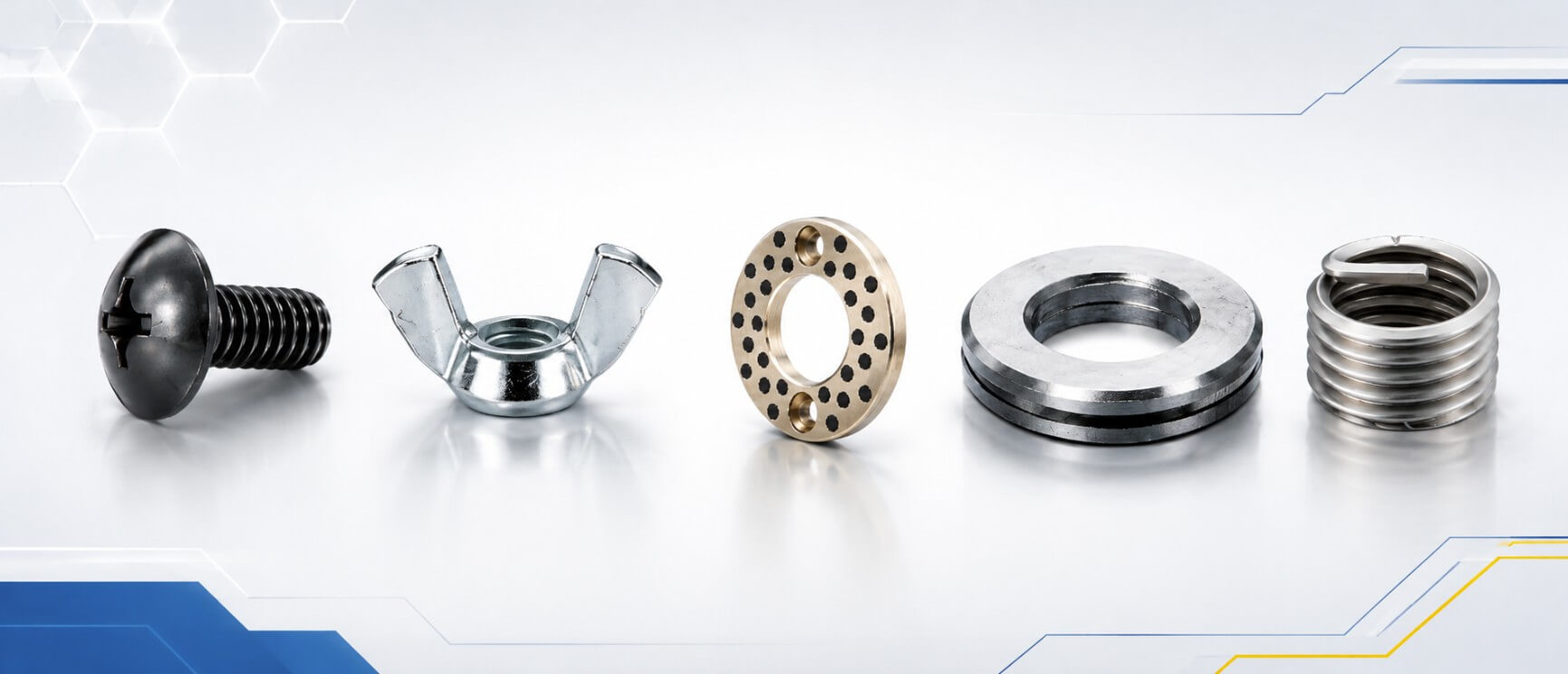
Industrial fasteners are used in nearly every type of mechanical assembly, but you definitely can’t base your needs on thread size alone. This guide helps to explain the main types of industrial fasteners and related hardware, including common head styles, specialty nuts, washers, inserts, spacers, pins, and other installation components. It focuses on practical differences between fastener types so engineers, maintenance teams, and buyers can better match the hardware to the load, environment, installation method, and service requirements of the assembly.
What Are Industrial Fasteners?
To put it in the most basic terms possible – Industrial fasteners are mechanical hardware used to join, secure, position, or retain parts in an assembly. They include common threaded components such as screws, bolts, and nuts, as well as supporting hardware like washers, pins, inserts, spacers, rivets, and retaining clips. In industrial applications, these parts are used in equipment builds, machine frames, tooling, fixtures, panels, enclosures, conveyor systems, automation components, and maintenance repairs.
The main purpose of a fastener is to hold parts together in a controlled and repeatable way. Some fasteners create clamping force between two components, while others are used for alignment, spacing, sealing, adjustment, or retention. For example, a socket head cap screw may be used to clamp a machine component in place, while a dowel pin may be used to keep parts accurately aligned. A washer may spread load across a surface, and a threaded insert may provide stronger internal threads in a softer base material.
Browse Industrial FastenersPractical Fastener Selection Process
Step 1: Identify the Joint Function
- Determine whether the fastener is used for clamping, locating, sealing, spacing, retaining, or adjustment.
- Consider whether supporting hardware, such as a washer, spacer, insert, or pin, is needed.
Step 2: Determine the Load and Environment
- Review the load type, including static load, vibration, impact, or repeated movement.
- Check for exposure to moisture, oil, chemicals, dust, heat, or outdoor conditions.
- Consider maintenance access if the assembly will need to be removed or adjusted.
Step 3: Choose the Head Style and Drive Type
- Match the head style to the required clearance, torque, and surface profile.
- Use low-profile or countersunk screws where space or flush mounting is needed.
- Use socket head or hex head fasteners where stronger tool engagement is required.
Step 4: Select the Nut, Washer, or Insert
- Use washers to distribute load, protect surfaces, or support oversized holes.
- Use lock nuts or locking features where vibration may loosen the joint.
- Use sealing washers where moisture, dust, or fluid entry is a concern.
Step 5: Confirm Material, Finish, and Size
- Verify thread size, pitch, length, head dimensions, and strength grade.
- Match the material and finish to the environment and mating parts.
- Confirm the fastener has enough thread engagement without interfering with nearby components.
Common Industrial Fastener Head Styles
| Fastener Head Style | Main Function | Best Used For |
|---|---|---|
| Socket Head Cap Screw | Provides strong clamping force with a compact cylindrical head and internal hex drive. | Machine assemblies, tooling plates, fixtures, linear motion components, and automation equipment. |
| Button Head Screw | Provides fastening with a low-profile, rounded head that reduces sharp edges and protrusion. | Covers, guards, panels, brackets, enclosures, and exposed fastener locations. |
| Flat Head / Countersink Screw | Sits flush with the mounting surface when installed in a countersunk hole. | Sliding surfaces, access panels, tooling plates, machine covers, and flush-mounted components. |
| Hex Head Bolt | Uses an external hex head for tightening with a wrench or socket. | Frames, brackets, machinery bases, structural joints, and heavy-duty clamping applications. |
| Pan Head Screw | Provides a slightly rounded head with a flat bearing surface underneath. | Sheet metal, light-duty brackets, covers, panels, and general equipment assembly. |
| Truss Head Screw | Uses a wide, low-profile head to spread force over a larger surface area. | Thin panels, sheet metal, plastic covers, guards, and applications where pull-through is a concern. |
| Set Screw | Secures one component against another without a traditional protruding head. | Shaft collars, pulleys, gears, knobs, couplings, and adjustment components. |
| Flange Head Screw / Bolt | Combines a fastener head with an integrated washer-like bearing surface. | Brackets, machine frames, sheet metal assemblies, and joints where load distribution is needed. |
Common Types of Industrial Nuts
| Nut Type | Main Function | Best Used For |
|---|---|---|
| Hex Nut | Provides a standard internally threaded mating component for bolts, screws, and threaded rods. | General machinery, brackets, frames, fixtures, and basic bolted assemblies. |
| Lock Nut | Helps resist loosening caused by vibration, movement, or repeated loading. | Moving equipment, machinery guards, frames, conveyor systems, and vibration-prone assemblies. |
| Flange Nut | Combines a nut with a built-in washer-like flange to spread clamping force. | Sheet metal, brackets, machine frames, and assemblies where a separate washer is inconvenient. |
| Cap Nut / Acorn Nut | Covers exposed thread ends with a closed, rounded end. | Exposed fastener locations, panels, guards, equipment covers, and assemblies where thread protection or appearance matters. |
| Barrel Nut | Creates a cross-dowel style connection where a bolt threads into a cylindrical nut from the side. | Frames, jigs, fixtures, furniture-style mechanical assemblies, and joints with limited access. |
| T-Slot Nut | Slides into a T-slot channel to create an adjustable threaded mounting point. | Aluminum extrusion frames, machine guards, workstations, sensor mounts, and modular automation structures. |
| Wing Nut | Allows hand tightening and loosening without a wrench. | Temporary fixtures, covers, access points, light-duty clamps, and adjustable assemblies. |
| Coupling Nut | Joins two externally threaded components together in line. | Threaded rod extensions, spacing assemblies, linkage adjustments, and long stud connections. |
| Square Nut | Provides a larger bearing surface than a standard hex nut and can resist rotation in some slots or pockets. | Channels, fixtures, older machinery, panels, and applications where the nut is captured in a square recess. |
Washers and Load Distribution Hardware
| Washer or Hardware Type | Main Function | Best Used For |
|---|---|---|
| Flat Washer | Spreads clamping force over a larger surface and helps protect the material under the fastener head or nut. | General machinery, brackets, frames, panels, and assemblies where surface protection or load distribution is needed. |
| Spring Washer | Adds a small amount of spring tension to help maintain pressure in the joint. | Light-duty assemblies, equipment covers, brackets, and applications with minor movement or settling. |
| Sealing Washer | Helps seal around a fastener hole using an elastomer, bonded seal, or sealing surface. | Outdoor enclosures, washdown equipment, fluid-adjacent assemblies, sheet metal covers, and panels exposed to moisture. |
| Lock Washer | Helps resist loosening by adding friction, tension, or biting action depending on the washer style. | Machinery, brackets, motor mounts, equipment frames, and assemblies exposed to vibration or repeated movement. |
| Belleville Washer | Acts as a conical spring washer to maintain preload or absorb small changes in joint movement. | High-load joints, bolted assemblies, thermal expansion areas, bearing preload applications, and machinery components. |
| Thrust Washer | Supports axial load and helps reduce wear between moving or rotating parts. | Shafts, pivots, hinges, linkages, rotating assemblies, and bearing-adjacent applications. |
| Spherical Washer | Helps compensate for slight angular misalignment between the fastener and mounting surface. | Machine bases, clamping systems, fixture setups, and assemblies where surfaces are not perfectly parallel. |
Installation Hardware and Related Fastener Components
| Hardware or Component Type | Main Function | Best Used For |
|---|---|---|
| Threaded Insert | Creates durable internal threads in a base material or restores damaged threads. | Aluminum parts, plastic components, castings, fixtures, housings, and parts that are assembled repeatedly. |
| Rivet | Creates a permanent or semi-permanent mechanical joint without needing access for a nut. | Sheet metal, brackets, panels, guards, covers, enclosures, and lightweight structural assemblies. |
| Cotter Pin | Locks a pin, shaft, or slotted nut in place to prevent movement or loosening. | Clevis pins, castle nuts, linkages, hinges, shafts, and retaining applications. |
| Dowel Pin | Provides accurate alignment and repeatable positioning between mating parts. | Tooling plates, fixtures, machine components, mold bases, jigs, and precision assemblies. |
| Clevis Pin | Creates a removable pivot or linkage connection, often secured with a cotter pin or retaining clip. | Linkages, hinges, brackets, actuators, control arms, and adjustable mechanical joints. |
| Retaining Ring | Holds components on a shaft or inside a bore by seating in a machined groove. | Shaft assemblies, bearings, gears, pulleys, housings, and rotating equipment. |
| Spacer | Creates a fixed gap between parts while allowing a fastener to pass through the assembly. | Panels, brackets, electronics, sensor mounts, covers, mechanical linkages, and frame assemblies. |
Parting Thoughts
MISUMI USA carries a wide range of industrial fasteners, including – screws, bolts, washers, nuts, and more. If you have any questions about fastening concerns for your next project or fix, please feel free to contact our product experts, and engineers. For more insights about industrial fasteners, and other manufacturing related articles be sure to check out our blog, and articles like – What Is a Helicoil and When Should You Use One?, Carriage Bolts vs. Hex Bolts, and more.
Disclaimer:
The content on this webpage is for informational purposes only. MISUMI makes no guarantees, expressed or implied, regarding the accuracy, completeness, or validity of the information. Performance parameters, tolerances, designs, materials, or processes should not be assumed to reflect third-party suppliers’ or manufacturers’ deliverables within MISUMI’s network. Buyers are responsible for specifying their part requirements.