In industrial automation, contactors are key components of the control systems, ensuring safe and efficient operation of electrical equipment.
A contactor is a switch that uses a low voltage signal to control high current circuits. They function similarly to relays but are designed to manage higher current loads. Contactors are commonly used in industrial automation to switch on and off motors, pumps, and conveyor systems. They are also used to operate high power lighting systems and HVAC systems.
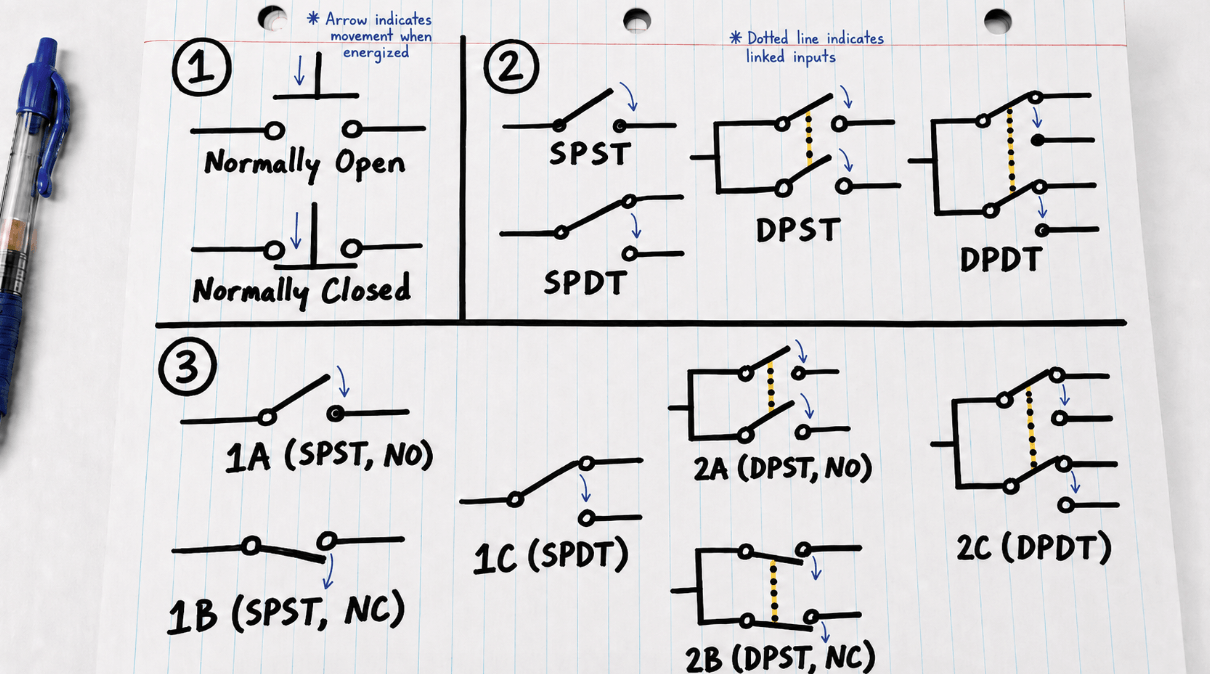
Contactors can be normally open (commonly notated as NO or 1a) or normally closed (NC or 1b).
In a NO contactor the contacts remain open when the coil is deenergized and close when the coil is energized. In a NC contactor the contacts remain closed when the coil is deenergized and open when the coil is energized.

There are two basic designs of contactors: electromechanical and solid state.
1.Electromechanical Contactors
In electromechanical contactors, the low voltage control signal energizes a coil (electromagnet) in the contactor that then opens or closes the internal contacts to activate or deactivate the high-power circuit.

2. Solid-State Contactors
Solid-state contactors use semiconductor devices like thyristors or triacs to control the high-power circuit.

Advantages and Disadvantages of Contactors
Electromechanical contactors are usually less expensive and can handle high current loads compared to solid-state contactors but can be noisier with buzzing and clicking sounds and have slower switching speeds than solid-state contactors. They can have shorter life spans than solid-state due to wear and tear of the internal moving parts.
Solid-state contactors are quieter than electromechanical due to no moving parts. They feature faster switching speeds and longer life spans. They can offer higher efficiency in high-frequency load applications as well as compared to electromechanical contactors.
Common Types of Contactors
The four most common types of contactors include:
- AC Contactors: used in AC applications
- DC Contactors: used in DC applications
- Thermal Overload Relays/Contactors: relays used in conjunction with contactors to protect motors and electrical systems from overheating
- Reversing Contactors: used where both forward and backward motion is required such as conveyors

Selecting the Right Contactor
When selecting a contactor for your application, consider the following factors.
- Load requirements: select a voltage equal to or higher the circuit requires. Select current rating higher than maximum current draw of the circuit including inrush currents.
- Contact Configuration: choose normally open or normally closed based on the control logic of the system.
- Coil Voltage: select the coil voltage based on the control voltage of the system.
- Environment: choose a contactor that has dust and moisture protection level for the environment the equipment operates in.
- Compliance: select a contactor that meets the safety standards set by your region.
Contactors are critical components to any control system, allowing low voltage control of high-power systems. Understanding their function and types allows you to choose the right contactor for your system.