

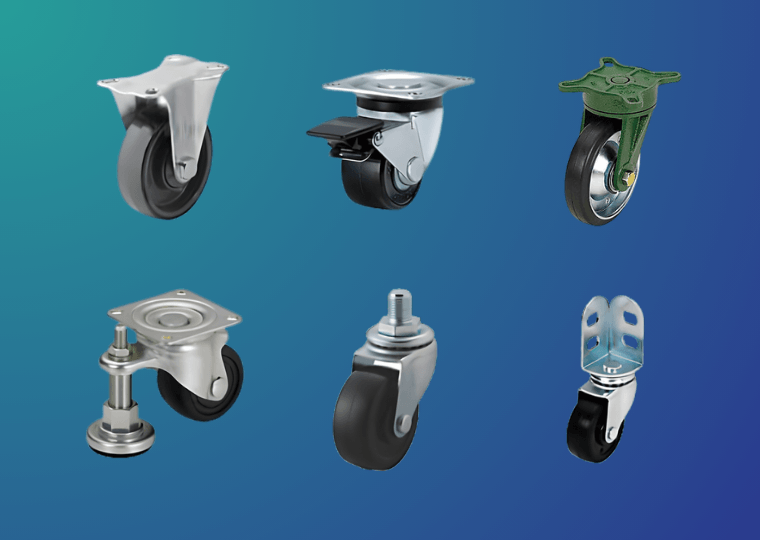
This article was written by product engineer, Grace Miller, and reviewed by product manager, Natalia Gruszka.
There are several different caster mounting types to choose from, depending on your applications’ needs. The method chosen determines how the caster attaches to the equipment.
Here is an overview of different options, common applications, key advantages, and a comparison of each type.

Caster Mounting Types
Selecting the correct caster mounting type is a critical design decision that affects load capacity, mobility, ease of installation, and long-term serviceability. The following sections outline the most common mounting configurations and their respective engineering considerations.
1. Plate Mount
Plate casters are secured to the base structure via a flat mounting plate fastened with four bolts. This configuration distributes the load across the entire plate surface rather than concentrating stress at a single point, offering higher load capacities compared to stem-based alternatives.

Plate mounts are available in two configurations: Swivel and Fixed.
Swivel
The mounting plate incorporates a bearing race that allows the caster to rotate 360 degrees. This provides excellent maneuverability, making swivel plate casters well-suited for applications where frequent directional changes are required.
| Swivel Caster Drawing | Common Applications | Key Advantages |
 | -Medical equipment -Restaurant and hospitality service carts -Warehouse order-picking vehicles | -Superior maneuverability in tight or confined spaces -Reduces operator effort when navigating complex routes -Compatible with brake attachments for added safety control |
Fixed
The mounting plate is rigidly attached in a single orientation, constraining movement to a straight-line path. Fixed plate casters are typically paired with swivel casters to improve directional control and stability.
| Fixed Caster Drawing | Common Applications | Key Advantages |
 | -Industrial carts and trolleys -Mobile workstations -Material handling equipment | -High-load capacity due to distributed load across the plate -Straightforward to remove and replace during maintenance |
2. Screw-In (Threaded Stem) Mount
Screw-in casters use a threaded stem that is inserted directly into a pre-tapped socket or insert in the base material. Installation requires no additional hardware beyond the caster itself, making this one of the fastest mounting methods available.

It is important to note that screw-in casters carry a lower load capacity than plate-mounted alternatives. Engineers should verify the stem thread specification, and the material of the receiving socket are appropriate for the expected loads and operating environment.
| Screw-in Mount | Common Applications | Key Advantages |
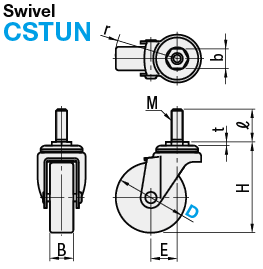 | -Display racks and stands -Light-duty carts | -Quick and tool-minimal installation -Compact footprint with no protruding hardware -Contributing to space efficiency in tight or consumer-facing designs |
3. Shock-Absorbing Mount
Shock-absorbing casters incorporate a spring mechanism that deflects under impact loads and absorbs vibration during transport. The spring rating should be selected based on the expected dynamic load and the frequency of surface irregularities the caster will encounter.

| Shock-Absorbing Mount | Common Applications | Key Advantages |
 | -Electronics carts -Medical equipment -Any environment involving uneven floors or transition surfaces | -Effective vibration damping protects sensitive cargo -Smoother movement; reduce operator fatigue -Reduced shock extends service life of the caster |
4. Leveling Mount
A leveling mount integrates an adjustable foot mechanism directly into the caster assembly, allowing the unit to serve as a mobile caster during transport and then be locked and leveled when stationary.
The leveling foot is typically actuated by a threaded spindle, providing fine height adjustment to compensate for floor irregularities.

| Leveling Mount | Common Applications | Key Advantage |
 | -Laboratory tables -Precision measurement equipment -Any machinery requiring a stable, vibration-free platform when in use | The dual-function design eliminates the need for a separate leveling foot adjacent to each caster. When locked, the leveling pad contacts the floor directly, increasing stability and resistance to unintended movement. |
5. Plug-In (Socket) Mount
Plug-in mounting consists of a stem that is press-inserted or snapped into a pre-installed socket, tube, or hole in the base structure. No threaded engagement or fasteners are required, allowing for faster assembly and disassembly without tools.
Keep in mind that plug-in mounts are not intended for heavy-duty applications. It’s important to evaluate the pull-out and shear resistance of the socket joint relative to expected load conditions before specifying this mounting method.

| Plug-In Mount | Common Applications | Key Advantages |
 | -Modular display systems -Temporary or reconfigurable structures | -Fastest assembly of any mounting method -No tools required |
6. Through-Hole Mount
Through-hole casters feature a mounting boss or top plate with a clearance hole, through which a bolt or fastener passes to clamp the caster rigidly to the base material. This creates a mechanically robust joint with a high resistance to both vertical loads and lateral forces.

| Through-Hole Mount | Common Applications | Key Advantages |
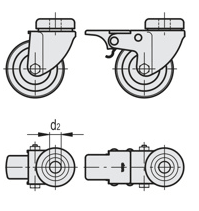 | -Heavy-duty machinery -Industrial carts -Structural equipment where maximum joint integrity is required | -Provides a strong, secure attachment with predictable clamp load -Well-suited for heavy-duty applications |
7. Angled Mount
Angled mount casters use a specialized angle plate, typically an L-bracket configuration, that accommodates mounting surfaces which are not perpendicular to the floor. The angle plate includes pre-drilled mounting holes to facilitate attachment to non-standard frame geometries.

| Angled Mount | Common Applications | Key Advantages |
 | -Equipment with rack-style frames -Specialized machinery | Angle mounting enables caster integration on non-standard or inclined frame members without requiring custom fabrication of the base structure. This offers flexibility in designs where conventional mounting is not feasible. |
How Different Caster Mounting Types Impact Performance
Selecting the right caster mounting type requires balancing three core performance criteria: stability, mobility, and load capacity.
These factors are often interdependent, so understanding how each configuration performs across all three dimensions is essential for making an informed design decision.
Choosing the right caster mounting method depends on several key factors specific to your application. Load capacity requirements should be the first consideration. Heavy-duty environments demand the structural integrity of plate, shock-absorbing, or through-hole mounts, while lighter applications can take advantage of the quick assembly offered by screw-in or plug-in stems.
Beyond load, engineers should evaluate the mobility needs of the equipment, the nature of the operating environment, and any space or assembly constraints that may influence mounting.
Serviceability is also worth factoring in early in the design process, as some mounting methods allow for faster field replacement than others.
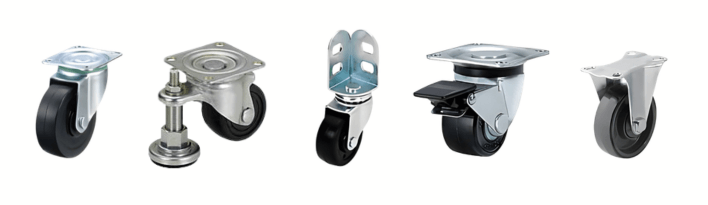
For a full line of configurable casters, leveling mounts, and accessories, click here.


