Enhancing Semiconductor Manufacturing Precision with Smart LAC Laser Autocollimators
There are no smartphones, tablets, or modern appliances without microchips. As the world becomes more interconnected and reliant on these tiny electronic components, producers become more keen on making them smaller and cheaper.
The cost of raw materials for this process tends to stay high, so it is the job of better technology to keep sizes small, reduce errors and imperfections, and keep costs competitive. A single mistake during the manufacturing process could cost hundreds of thousands of dollars, and as such, there is no room for error.
To prevent error throughout the fabrication process, great care is taken to ensure precise movement, precise alignment of key components, precision timing, and precision everywhere. This is achieved by using precision actuators like linear motor stages, precision manipulator robots, and tools to measure alignment where alignment is of utmost importance.
These components are meticulously set up and calibrated. Measurements throughout the fabrication process include things like surface flatness and parallelism at several points, and sometimes alignment of optical components used during fabrication.
One last detail, the tools used for these measurements cannot create particulate as that can contaminate the final product. Those factors make laser measurement instruments ideal for use in semiconductor fabs. Laser measurement is precise, repeatable, reliable, and does not produce any particulate as there are no moving parts and doesn’t require contact with the device under test (DUT).
The Smart Laser Autocollimator in Semiconductor Manufacturing
Flatness, parallelism, and precise angular offset alignment of the wafer handling and optical components are crucial for the semiconductor manufacturing process.

An efficient way to achieve this is by using a laser autocollimator. Laser Autocollimators measure the angular offset of a reflective surface or optical system by using a laser, reflected or refracted, through the sensors collimated lens and into a CCD sensor. The resulting reading is then used to determine the offset of the device under test. The collective lens on the H410 Smart Laser Autocollimator(Smart LAC) to read the same angular offset between 10mm and 300mm.


Sometimes, the device needs to be flat, like a wafer. Measuring the reflection from the wafer compared to a parallel surface will determine if the wafer is as flat as desired. Sometimes the device is a camera lens with several layers that need to be in tight alignment so that your Instagram selfie is as clear as can be.
Measuring the reflection and/or refraction of a laser light through the lens components will ensure that the components are aligned properly, and your selfie isn’t blurry. Any laser autocollimator could achieve this, so what makes ours so smart?
Laser autocollimators often require manual adjustment of the laser intensity and shutter speed in order to get a clear reading. MISUMI’s laser autocollimator can adjust these parameters automatically, saving time and effort for other important tasks.
Add the fact that the sensor head is small enough to fit into machinery and the processing unit can interface via ethernet, RS232C, or general IO, and it makes MISUMI’s laser autocollimator the smart choice for your semiconductor fab. Let’s review a few smart areas to apply the Smart LAC.

Common Application: Lithography, Laser Autocollimators in Photolithography
We’ve all been out in the sun for a while only to end up an uneven tan from wearing a t-shirt and an Apple Watch. Photolithography works kind of like that. During the photolithography process a silhouette of the circuit pattern is projected onto the silicon wafer.
UV light that is sent through a transparent sheet with the circuit design printed onto it, called the photomask, then through a projection lens to focus onto a specific area on the silicon wafer. The pattern imprints onto the surface of the wafer thanks to the wafer’s photoresist coating. The photoresist coating is removed by the UV light, leaving only the silhouette of the printed circuit design on the wafer.
Now, an “uneven tan” on a wafer is a bigger problem; it’s an expensive mistake! It is estimated that photolithography accounts for about 35% of a wafer’s processing costs, according to The National Institute of Standards and Technology (NIST). While manufacturing practices have improved over the last 20 years, costs remain significant as chip sizes have decreased and chip complexity has increased.
Alignment of the photomask, projection lens, and wafer are mandatory for achieving high complexity at a lower cost. If the projection lens and base plate are not aligned correctly, the circuit pattern will not properly imprint onto the wafer’s surface and the circuit will not work as intended. If you rely on that microchip to provide an accurate number on an oximeter during a health screening, you want it to work as intended. Furthermore, a defective circuit is costly for the manufacturer as well. Thus, the importance that the projection lens is aligned with the wafer surface cannot be understated.
While alignment methods could vary, it’s easy to see how the Smart Laser Autocollimator is tailor made for projection lens and wafer base plate alignment. Flatness of the wafer base plate and projection lens refraction are exactly what the device was designed to measure.


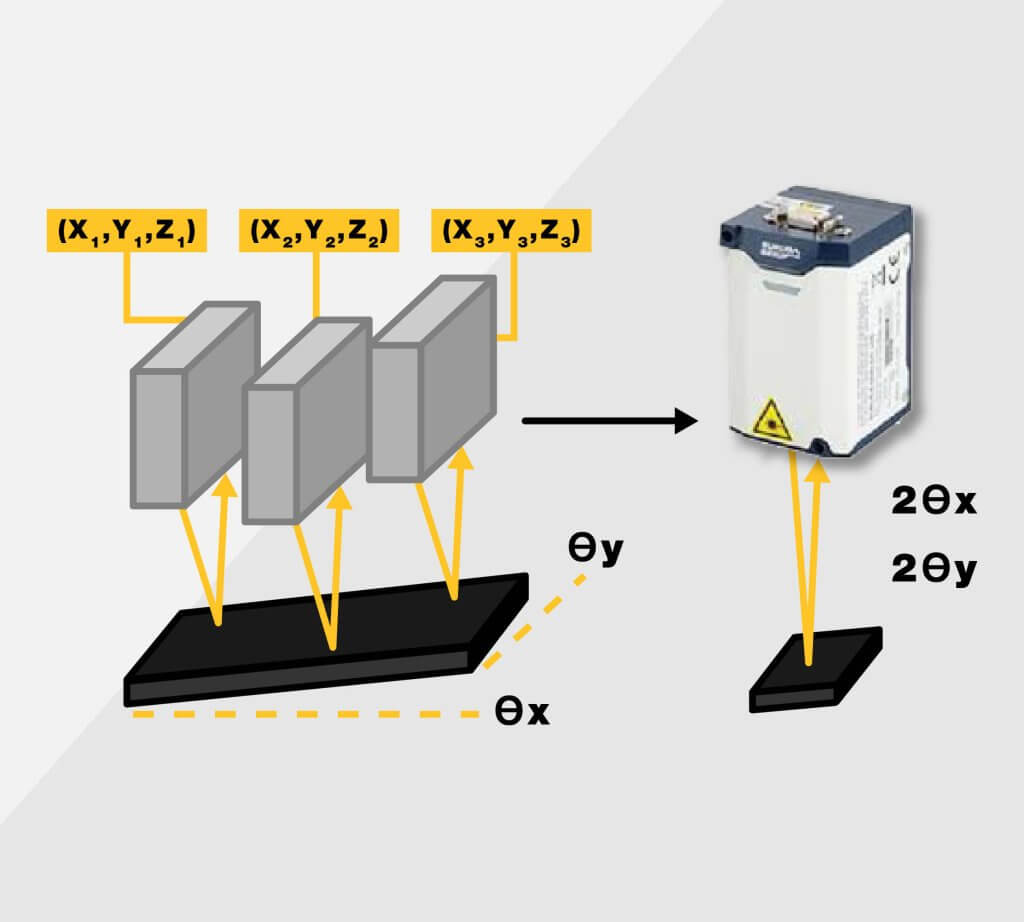
Another place the Smart LAC can be used during the lithography phase is to make sure the wafer’s base plate is flat, contributing to the precision of the process. Base plate alignment is often done using displacement sensors.
The displacement sensors need to be adjusted each time the setup changes, which takes time. Replacing two displacement sensors with one Laser Autocollimator can free up both time and space without sacrificing quality. The Smart LAC only requires one sensor and has a measurement range between 10mm and 300mm, which reduces or eliminates the need to readjust after each setup change.

Common Application: Backgrinding, Laser Autocollimators in the Grinding Process
Did you know your smartphone has more memory capacity and computing power than the much bigger desktop computers of the 90s and early 2000s? Even the original Apple Watch is more powerful than NASA’s Perseverance rover sent to Mars, which was achievable thanks to a combination of advancements in lithography, etching, materials science, and backgrinding.
During backgrinding, the wafer is sent to a grinder to thin it out and polish the newly etched surface. A course grind is typically done first and can remove about 90% of excess material on a 200mm wafer, a fine grind is done later to polish the wafer surface. Thinning out the chips allows for better heat dissipation, and for chip stacking to occur, which enables more complex designs.
Now, imagine what might happen if the grinding wheel and wafer surface aren’t parallel. After sending the wafer through lithography, etching, doping, CVD, metallization, and CMP it would be an expensive tragedy to have backgrinding fail. How do you make sure the grinding plate and wafer are parallel?
You may be at a point where you can predict the answer I’ll give you, and why not? It makes perfect sense! A device that can measure the flatness of a surface with an arcsecond of resolution can ensure that a grinding wheel and wafer are within their parallel tolerance. That device is the Smart LAC.
The wafer rests on a surface plate during the grinding process. The Smart LAC can ensure the surface plate is flat in reference to the grinding wheel and thus able to achieve consistent, uniform thickness and surface quality.

The Smart LAC Delivers Precision and Speed
Semiconductor manufacturing requires both precision and speed with little room for error as chip technology advances. Chips are becoming smaller and more complex, and their demand shows no signs of slowing down. Precise instrumentation is needed to ensure smaller and more complex chipsets can be produced efficiently and with high quality.
The Smart LAC is an efficient tool for measuring flatness and parallelism of surfaces and lens alignment for various applications. This happens to align with the needs of the semiconductor manufacturing industry where precision is paramount.
Two prominent examples in the U.S market include lithography and backgrinding:
- Lithography requires a properly aligned lens and flat wafer base plate.
- Backgrinding requires a flat surface plate for parallelism between the wafer surface and the grinding wheel.
Both applications are a perfect fit for the Smart Laser Autocollimator. Furthermore, factoring the size of the sensor head and interfacing capability of the processing unit makes the Smart Laser Autocollimator an intelligent choice for machine integration or laboratory use.
Specialized MISUMI products are used to ensure precise alignment of optical and electronic components within flow cytometer equipment. MISUMI offers the following products:
Smart Laser Autocollimators, prisms, and mirrors are integral components that contribute to the precision and reliability of these advanced instruments.