Fasten your seatbelts! Diving into fasteners can be a wild ride, as fasteners come in many shapes, sizes, and materials. The MISUMI fastener selection guide helps you find what you need. It explores different types of fasteners common in industrial automation.
Jump to Fastener Type:
What is a Configurable Fastener?
Fasteners come in many shapes, sizes, types, and materials (like metals, plastics, and composites). At MISUMI, it’s easy to find a standard fastener and configure its features, size, and material to meet your needs.
LEARN MORE ABOUT MISUMI’S CONFIGURABLE MODEL.
What Are Clean and Pack Fasteners?
Clean and pack is a cleaned parts option available through MISUMI. It’s a cost-effective and faster alternative to getting parts cleaned by a third party. Many of the fasteners highlighted in this guide (plus many more) are available for purchase pre-cleaned.
The three clean and pack options include:

Screws
The most common fastener type are screws. Screws are threaded fasteners that secure connections between two metal pieces. Screws are the most common fastener type for securing connections between two metal pieces. Screws are suitable for a wide variety of industrial automation applications.
Here are some common screw types:
1. Socket Head Cap Screws with Hole
Socket head cap screws with holes have a thick flanged head, known as a “cap.” These screws are engineered to integrate with corresponding internal machine threads. The socket head cap screw has a recessed drive slot at the top. The most common drive type is hexagonal. These types of screws also have a throughhole on the side of the cap head, which is made to hold a metal wire.

2. Ultra-Low Head Cap Screws
Ultra-low head cap screws have a short and flat head and are known as a space-saving fastener. These types of screws are designed to integrate with corresponding internal thread profiles. To accommodate the flat head profile, the hexagonal drive slot is embedded into the screw. They are designed to fit into applications where there is minimal clearance from other assembly components, where space is at a premium, and access to the joint is restricted.

3. Button Head Cap Screws
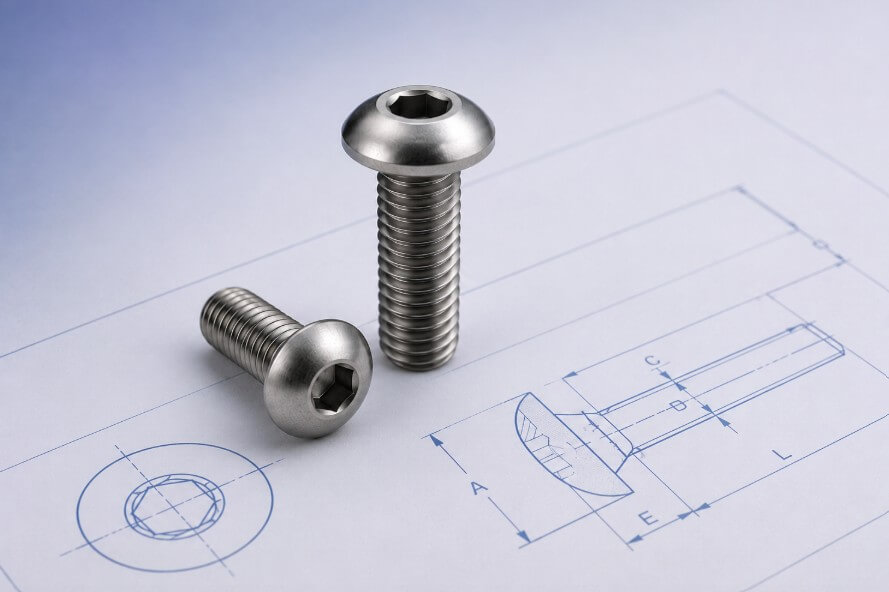
Button head cap screws have many similarities to socket head cap screws, but the key differentiator is the round head. These screws are made to engage with corresponding internal threads of machinery. They include a recessed drive slot at the top of its cap, typically utilizing a hexagonal shape to accommodate a hex drive tool.

4. Cross Recessed Flat Head Machine Screws
Cross recessed flat head machine screws may sound sophisticated, but they’re essentially standard machine screws with a cross-drive head. This crossdrive is typically compatible with conventional screwdriver heads like Phillip’s headdriver. Much like the other machine screws mentioned here, these screws are designed to align with specific internal thread profiles.

5. Captive Screws
Captive screws can be as simple as a screw or a bolt with an unthreaded portion of the shank and a locking washer to prevent the removal of the screw.
However, the captivating mechanism of the joint can also be achieved by welding the bolt, press fitting the bolt through the top joint hole, or broaching.
No matter the method employed, as long as the screw or bolt is contained within one of the mating joint layers, the fastener is considered to be captured.

Bolts
Bolts are designed for insertion through holes in assembled parts and are normally intended to be tightened or released by torquing a nut.
Here are some common bolt types:
1. Fully Threaded Bolts
Fully threaded bolts have threads that run the entire length of the bolt. These types of bolts are often used on applications that require grip strength. They are also seen in automotive parts, such as body panels.

2. Hex Bolts
Hex bolts can generate impressive clamping forces, guaranteeing that joints exposed to high mechanical loads are securely fastened. Hex bolts are frequently utilized across various machine designs in conventional drive systems.

3. Eye Bolts
Eye bolts have a loop at one end (the eye) and are used to lift an object, secure a point, or route wire and cables. Eye bolts come in a variety of materials and finishes, offering different capabilities depending on the application’s needs.

4. U-Bolts
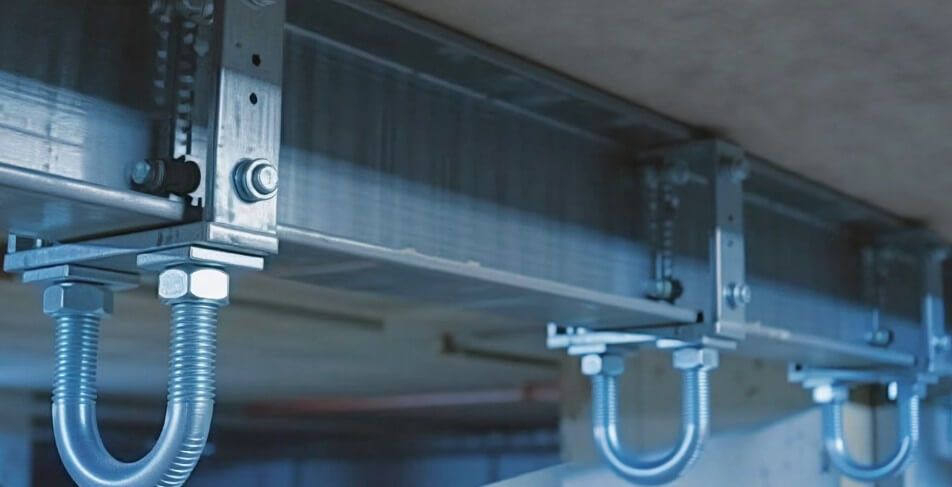
U-bolts have threads on both ends of the u-shaped design. U-bolts are not fully threaded and function to clamp an object in place. Some applications include support automotive piping on drive shafts and exhaust systems.

Washers
Washers come in a variety of materials depending on your needs. Washers have a variety of uses, which makes them a very common fastener in all industries. Some uses include a spring wear pad, a preload indicating device, a locking device, or to prevent or reduce vibration.
Note: Washers and precision spacers are similar in shape, but their use cases are different. Click here to learn the difference between washers and spacers.
Here are some common washer types:
1. Flat Washer
Flat or plain washers are circular and flat plates with a hole in the center and sit snugged underneath a screw head. They are often designed in metallic, usually carbon or stainless-steel alloy, but are also available in some non-metals as well.

2. Spring Washer
Spring washers are designed to ensure the spring sits flat if clamped down in the joint. They contain design features that cause the spring only to sit flat if clamped down in the joint. Spring washers have specific engineered features to provide a spring action into the joint when it is fastened down on the joint.
RELATED READING: SPRING WASHER VS. FLAT WASHER: HOW TO CHOOSE CORRECTLY

3. Split Lock Washer
Split lock washers have a gap in their circular design. They are used to help prevent vibration from loosening a threaded fastener.

Nuts
Nuts often act as a pair for a bolt of similar size, shape, and thread pattern. It mates with a bolt, or sometimes a screw, as it creates a secure joint holding the parts together. Like bolts, nuts come in different shapes and designs, with the common ones being hex and weld nuts.
Here are some common nut types:
1. Hex Nuts
Hex nuts have an internal thread used in conjunction with a bolt or screw. This allows for multiple parts to be secured together. Its hexagonal shape makes it easy to tighten and loosen with standard tools. They are used in a wide range of applications, including securing machinery and even automotive parts.

2. Flanged Nuts
Flanged nuts have a unique design that includes a wide flange at one end. They are commonly used in industrial automation applications that require vibration resistance. They are also used to help distribute loads and align fasteners.
RELATED READING: DESIGN CONSIDERATIONS FOR FLANGED NUTS AND FLANGED SCREWS

3. Weld Nuts
Weld nuts are a type of captive fastener designed to weld to another metal object. This creates a strong threaded bond. Depending on the application, there are different types of weld nuts, from tab-spot weld nuts to flange weld nuts.

4. Wing Nuts
Wing nuts, also known as butterfly nuts, are designed to be able to install and remove them simply by turning them.

Rivets
Rivets are permanent fasteners and are the go-to fasteners for automotive and aerospace.
They are lightweight, featuring smooth shafts with no threading. They are cylindrical, resembling bolts and screws, featuring a distinct head and a tail. However, they join materials together through the deformation of their end, creating a secure connection
Here are some common rivet types:
1. Blind Rivets
Blind rivets are permanent fasteners that have a tubular design with a slotted or countersunk head and mandrel. They provide long-term strength and durability.

2. Solid Rivets
Solid rivets, also known as “structural rivets,” are known for their strength and reliability. The aerospace industry often uses them, and you can see them on structural parts of an aircraft. In fact, workers use thousands of them to assemble an aircraft frame.

3. Push-In Rivets
Push-in rivets have a cylindrical design and are pushed into place to secure two or more items together. Unlike solid rivets, they are light-duty and can be reused or removed. They are commonly made of plastic, but some also come in metal.

Conclusion
No matter what the application, MISUMI has a wide assortment of fastener types and offers free CAD downloads of parts, short lead times, and no minimum order quantity.